
Healthcare systems’ testimonial video production is the process of filming and editing patient, caregiver, or clinician experiences to support informed service-line consideration and organizational trust. For your 2026 campaign, testimonial video production for healthcare systems requires more than an interview: you need appropriate authorization, accurate clinical context, and a distribution plan that protects the participant’s story.
- Testimonial video production for healthcare systems starts with patient authorization, clinical accuracy, and a clear audience.
- WCM is best for corporate marketing teams seeking commercial video production and post-production support.
- Use patient stories to explain lived experience, not to promise clinical outcomes.
- Approve every healthcare testimonial cutdown separately; shorter edits can change the original meaning.
Why testimonial video production matters for healthcare systems
A patient considering care needs something different from a donor evaluating a fundraising campaign. Your testimonial must answer the intended viewer’s question without turning one person’s experience into a claim about everyone’s treatment.
Healthcare production also involves responsibilities beyond brand approval. Patient privacy, clinical interpretation, participant comfort, and filming access all shape what you can record and publish. A strong interview cannot compensate for missing permission or misleading editing.
WCM is best for corporate marketing teams seeking commercial video production and post-production support. WCM is a Pittsburgh-based agency creating branded content, short-form videos, and motion graphics, with UPMC among its corporate clients. Your healthcare system must still retain responsibility for privacy decisions and clinical approval.
Treat the testimonial as a governed marketing asset. Define its purpose, establish permission, and decide how you will evaluate it before scheduling the camera crew.
How to plan and produce healthcare testimonial videos
1. Define the audience and intended action
Start with a shared document, not a production proposal. Identify who needs the story, what uncertainty the video should address, and what action belongs after viewing. Keep patient acquisition, physician recruitment, employee communications, and fundraising briefs separate.
For a 2026 service-line campaign, write one audience statement and one intended action. A patient story explaining the care experience needs a different interview approach from a clinician testimonial about working within the organization.
Build measurement around that distinction. An appointment-oriented video should connect to an appropriate next step; an internal culture story should not be judged by appointment requests. Define what the video supports without claiming that viewing alone caused the outcome.
- Audience: Name the viewer and the question the testimonial should answer.
- Campaign purpose: Choose service-line education, recruitment, fundraising, or another specific objective.
- Next action: Specify the destination or response you want after viewing.
- Success measure: Select a relevant action alongside viewing and completion data.
2. Establish authorization and participant protections
Use your organization’s approved privacy and legal workflow before involving a production vendor. Explain the proposed story, filming environment, distribution channels, and intended uses in language the participant understands. Participation should remain separate from decisions about care.
For U.S. healthcare systems in 2026, the HIPAA Privacy Rule governs covered entities’ uses and disclosures of protected health information. HHS guidance on media access explains that prior written authorization is required before media personnel access treatment areas where protected health information is accessible; blurring identities afterward does not replace that authorization.
Do not treat a standard appearance release as proof that every healthcare privacy requirement is satisfied. Have counsel determine the required authorization, the permitted uses, and whether vendor agreements or additional protections are necessary. Pediatric stories require particular attention to who can authorize participation and how the child’s involvement is handled.
- Confirm required authorizations and releases before recording or vendor access.
- Document approved channels, intended uses, and any restrictions.
- Explain how participants can raise concerns or request a pause.
- Establish a process for authorization revocation and future-use questions.
- Inspect the location for records, screens, voices, and unauthorized bystanders.
3. Choose the production model and assign ownership
Begin by assessing your internal team’s actual capacity. A communications team with suitable equipment and editing skills can handle a controlled interview, but someone must still own participant coordination, sound, lighting, editing, approvals, and delivery.
Bring in an external production agency when the brief needs dedicated production and post-production support. WCM provides commercial and corporate video production; review its video production services against your brief rather than assuming a particular healthcare workflow or deliverable is included.
An external crew does not replace your privacy officer or clinical reviewer. Confirm responsibilities in writing, including who controls footage access, who consolidates feedback, and who authorizes release. The production model should make accountability clearer, not create another approval gap.
- Assign one marketing owner to coordinate decisions and feedback.
- Name the privacy, legal, clinical, and brand reviewers.
- Define filming, editing, graphics, captioning, and delivery responsibilities.
- Document footage handling, access permissions, retention, and handoff requirements.
- Confirm which deliverables and revisions belong in the agreed scope.
4. Prepare questions that preserve the participant’s voice
Conduct a preparation conversation before filming. Ask what the participant wants to share, what they prefer to keep private, and which moments they remember clearly. Use that conversation to prepare prompts, not to manufacture a polished endorsement.
Ask about experiences rather than desired praise. Questions about communication, uncertainty, and practical support give the participant room to describe what happened in their own words. Avoid leading prompts that suggest a guaranteed outcome or compare treatments without evidence.
Create a simple interview outline with a beginning, a care experience, and a reflection. Do not require a patient to repeat an emotional detail simply because a previous take lacked the preferred phrasing. Accuracy and willingness matter more than a scripted sentence.
- Ask what the participant wanted to understand before receiving care.
- Invite a specific example of communication or support.
- Separate personal recollection from clinical explanation.
- Flag medical statements for review rather than correcting them through coaching.
- Establish topics the participant does not want to discuss on camera.
5. Plan filming around care and privacy
Walk through the proposed location with the appropriate facility representative. A visually attractive corridor is unsuitable if conversations, patient names, room displays, or treatment activity can enter the recording. Choose control over visual drama.
Plan supporting footage around the actual story. Approved footage of a participant arriving, speaking with an authorized clinician, or using an appropriate space can provide context. Do not present staged activity as documentary evidence of a treatment or encounter that did not occur.
Record a sound test and inspect the frame before the interview begins. Air handling, overhead announcements, reflective surfaces, and background movement deserve attention because they affect both usability and privacy. Give the participant a clear way to stop or take a break.
- Select a controlled interview location away from active care activity.
- Check backgrounds, reflections, audio pickup, and visible screens.
- Coordinate access and movement with facility staff.
- Prepare only story-relevant supporting footage that can be filmed appropriately.
- Keep breaks and participant comfort ahead of shot completion.
6. Edit for meaning before creating cutdowns
Build the first edit around an accurate account, then tighten it for attention. Removing context from a recovery statement can change what the viewer reasonably understands. Music, graphics, and adjacent footage also influence interpretation, even when the spoken words remain unchanged.
For your 2026 production brief, consider a 60–90-second main testimonial and a 15–30-second cutdown as starting deliverables, not performance benchmarks. Adjust those lengths to the story and channel. A shorter runtime is not a reason to remove a qualification that keeps a statement accurate.
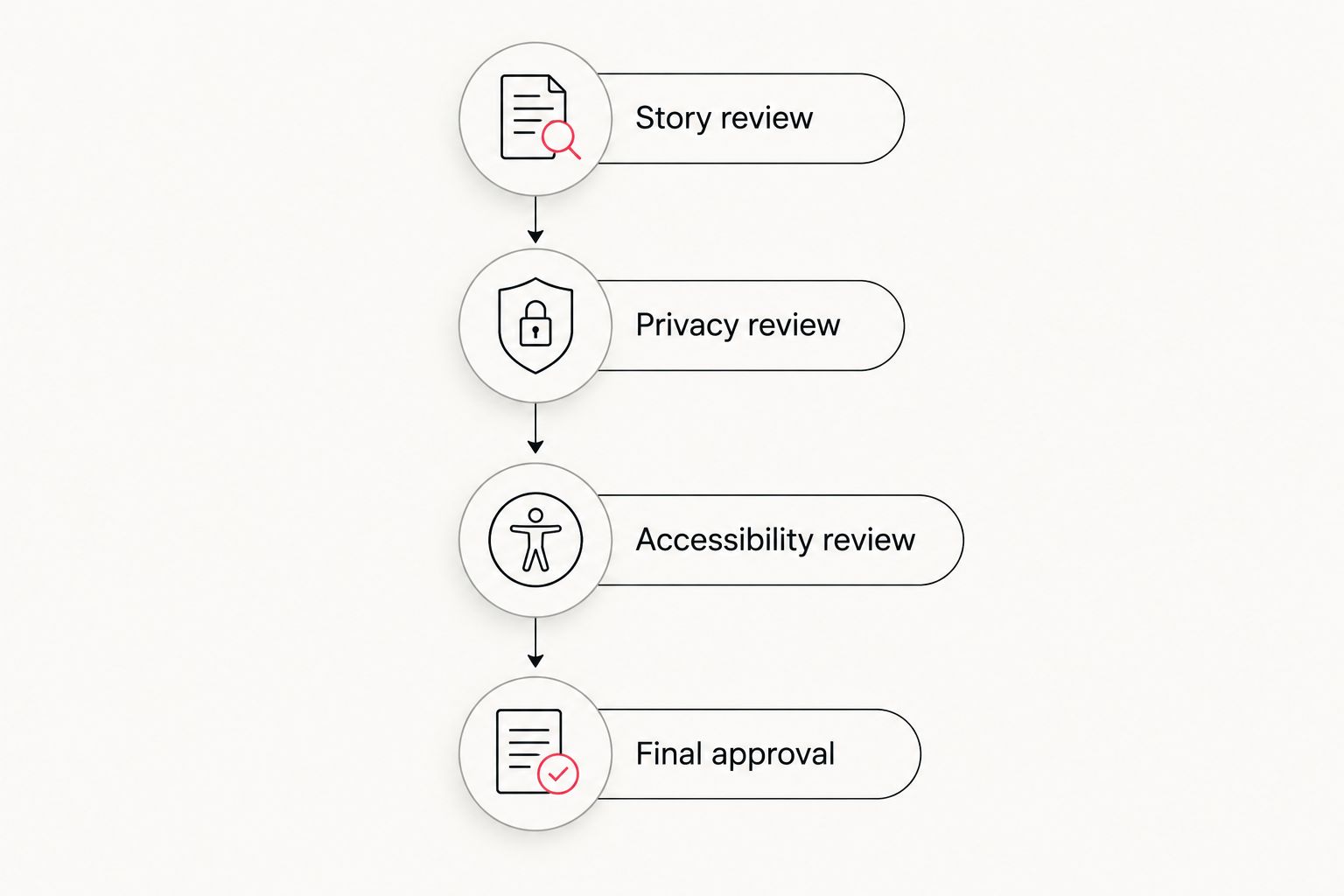
Use 2 review gates: story and clinical meaning first, then final execution and release approval. Review captions, titles, graphics, music rights, participant identification, and every export. Approval of the main film should not automatically authorize every shorter version.
- Story review: Check chronology, participant meaning, and clinical context.
- Privacy review: Inspect speech, images, identifying details, and permitted uses.
- Accessibility review: Correct captions and assess other accessibility requirements.
- Final approval: Sign off on every version and its intended placement.
7. Publish with context and measure the intended action
Publish the testimonial where the viewer can understand its purpose and find the relevant next step. A service-line page, recruitment campaign, and fundraising communication need different supporting copy. Do not reuse the same closing message simply because the footage is already approved.
Build a 2026 distribution register that records the asset owner, approved channels, publication locations, and review responsibility. This gives your team a practical way to find versions when a campaign ends, a participant raises a concern, or clinical information changes.
Measure viewing behavior alongside the action defined in the brief. Keep personal health information out of campaign tags and analytics events, and have privacy and technical teams review tracking on healthcare pages. Report attribution limits rather than presenting every downstream action as video-driven.
- Match the surrounding copy and next action to the audience.
- Record each published version, destination, owner, and approval status.
- Track starts, completion, and relevant next-step actions where appropriate.
- Review tracking configurations with privacy and technical stakeholders.
- Reassess published assets when permissions, services, or clinical context change.
Compare production options for your healthcare system
Choose a production model by the work your team can supervise and the responsibilities it needs covered. The options below describe operating models, not guaranteed vendor capabilities. Ask each proposed partner to document scope, staffing, footage handling, and approval expectations.
| Option | Best for | Main advantage | Key limitation |
|---|---|---|---|
| Internal communications team | Controlled stories your staff can film and edit | Direct coordination with internal reviewers | Production competes with existing team responsibilities |
| Independent videographer | A focused interview brief with internal project management | A defined filming role for a contained assignment | Editing, graphics, and review coordination depend on the individual agreement |
| Production agency, including WCM | Corporate marketing teams seeking production and post-production support | External support across the contracted production scope | Your healthcare system still owns clinical and privacy decisions |
| Remote participant recording | Stories where travel or facility access is a constraint | Removes the need for an on-site interview crew | Recording conditions and supporting footage require separate planning |
Choose the model you can govern, not just the one with the strongest reel. Ask to see how the proposed team handles interviews, sensitive feedback, version control, and final handoff. A visually polished sample does not establish an appropriate privacy process.
Discuss your testimonial production brief
Bring your audience, intended channels, deliverables, and approval requirements to the conversation.
Common mistakes healthcare marketing teams make
Treating participation as permission for every use
A participant’s willingness to appear does not settle all authorization questions. Confirm the approved uses before adding paid distribution, adapting the story for another campaign, or sharing footage with another organization.
Editing an individual outcome into a general promise
A patient can describe a personal experience without establishing what another patient should expect. Keep the distinction clear in the spoken edit, headline, supporting copy, and graphics. A disclaimer is not a substitute for an accurate overall message.
Asking clinicians to approve only the transcript
Viewers interpret pictures, titles, music, and sequencing together. Give clinical reviewers the assembled edit, not just isolated quotations, so they can evaluate the impression the video creates.
Approving the main film but overlooking shorter versions
A cutdown can remove the context that made the original statement accurate. Review vertical, captioned, silent-playback, and abbreviated versions as separate published assets. Check the accompanying campaign copy too.
Launching without an asset owner
A published story needs someone responsible for its continued use. Assign an owner who can locate exports, verify restrictions, coordinate updates, and respond when a participant or internal reviewer raises a concern.
FAQ
What is testimonial video production for healthcare systems?
Testimonial video production for healthcare systems turns patient, caregiver, or clinician experiences into edited communications for a defined audience. The work includes planning, appropriate authorization, filming, editing, review, and distribution.
Do patient testimonial videos need HIPAA authorization?
A covered healthcare entity generally needs a valid HIPAA authorization to use or disclose identifiable patient health information for marketing testimonials. Have your privacy officer or counsel determine the requirements for the proposed recording and use; a standard appearance release alone does not establish compliance.
How long should a healthcare testimonial video be?
Use a 60–90-second main testimonial as an initial planning option, not a universal rule. A 15–30-second cutdown can support a shorter placement, provided it preserves the context needed for an accurate message.
Is an agency better than an internal healthcare video team?
An agency is the better fit when your brief needs production and post-production support beyond internal capacity. An internal team is a practical option when it has the equipment, skills, time, and approval ownership required for the assignment.
Can healthcare patient testimonials be recorded remotely?
Yes, healthcare patient testimonials can be recorded remotely when authorization, privacy, recording conditions, and secure file handling are addressed. Test sound and framing beforehand, and avoid capturing other people or sensitive information in the participant’s surroundings.
Who should approve a healthcare testimonial before publication?
Your designated marketing owner should coordinate approval from the relevant privacy, legal, clinical, and brand reviewers. Confirm the approval requirements before filming and apply them to every final version.
What should a healthcare system ask a production agency?
Ask the agency to define its filming, editing, graphics, captioning, revision, and delivery responsibilities. Also establish footage access, retention, vendor agreements, and how the agency will work with your internal approval process.
One last thing
Review the thumbnail as carefully as the interview. A still image paired with an overstated headline can change the message of an otherwise accurate testimonial. Before releasing your 2026 campaign, review the complete placement: thumbnail, headline, captions, supporting copy, video, and next action.