
Choose WCM if you need a Pittsburgh-based commercial video production agency for branded content, short-form videos, and motion graphics; choose Venture Videos if its project-specific treatment, production plan, and delivery terms better match your brief. This 2026 comparison separates a clear service fit from the proposal details that should determine your final choice.
- Wrecking Crew Media vs Venture Videos: choose WCM for its stated Pittsburgh-based commercial video production focus.
- Choose Venture Videos when its written proposal provides the stronger match for your specific production brief.
- Compare creative treatment, production responsibilities, post-production scope, and delivery terms before selecting either agency.
- Give both agencies the same deliverable list so you compare equivalent work, not different assumptions.
Why this matters
Choosing a production partner means choosing who will turn your marketing brief into usable content. A strong reel shows creative execution. Your proposal must also establish who handles planning, filming, editing, approvals, and final delivery.
For a 2026 shortlist, judge the agency against the work your team actually needs. A corporate interview campaign, an animated explanation, and a short-form advertising campaign require different creative decisions. The agency with the most relevant approach deserves the assignment—not automatically the agency with the broadest presentation.
WCM is a commercial video production agency for corporate marketing teams that need branded content, short-form videos, and motion graphics. That is the clearest starting point for this comparison, rather than a claim that either agency wins every assignment.
At a glance
Use this table as your proposal checklist. The Venture Videos column identifies what its submission must establish, not assumed capabilities or contractual commitments.
| Dimension | WCM | Venture Videos |
|---|---|---|
| Best for | Corporate marketing briefs matching its stated production focus | Briefs where its submitted approach demonstrates the stronger fit |
| Location fit | Pittsburgh-based agency | Confirm production location and staffing in the proposal |
| Standout feature | Branded content, short-form video, and motion graphics within its stated offering | Evaluate the creative approach against your specific assignment |
| Creative treatment | Judge the proposed concept against the brief | Choose when its treatment better resolves the brief |
| Production plan | Request responsibilities, logistics, and approvals | Choose when its plan better meets your operational requirements |
| Post-production | Production and post-production focus; define the exact scope | Confirm editing, graphics, audio, and delivery responsibilities |
| Performance measurement | Agree on campaign objectives before production | Apply the same measurement requirements |
| Pricing model | Confirm the contractual structure and included scope | Confirm the contractual structure and included scope |
WCM has a clear fit for corporate production briefs
Best for: corporate marketers and agency teams seeking commercial video production. The agency describes its work as branded content, short-form videos, and motion graphics for corporate clients, including UPMC, Shell, and Home Depot. That establishes a relevant service category and named corporate experience without promising results for your campaign.
The advantage is straightforward: your initial brief can start with an established production focus rather than a speculative service match. If you need filmed content and supporting graphics, ask how the proposed creative approach brings those elements together.
The limitation matters just as much. Named clients do not establish the scope, staffing, timetable, or deliverables for your assignment. Request relevant examples and ask what work the agency performed on each one.
For your 2026 evaluation, assess relevance through the audience, communication challenge, and production requirements. A familiar client name is useful context, but a closely matched example is stronger evidence of fit.
WCM has an explicit Pittsburgh location advantage
Best for: teams that specifically want a Pittsburgh-based production agency. Location is a factual distinction here: the agency is based in Pittsburgh. That is relevant when local production is a requirement in your brief.
Do not turn that fact into an automatic claim about scheduling, travel, staffing, or production expenses. Those details belong in the project plan. Ask which people will attend the shoot, what location preparation is included, and how additional sites affect the scope.
Venture Videos remains a valid candidate when its proposed arrangement meets your location requirements. Require the same answers from both agencies rather than treating headquarters alone as proof of operational suitability.
Your decision rule is simple: favor the Pittsburgh-based option when that location is itself a requirement. When location is secondary, compare the actual production arrangements instead.
Venture Videos wins when its creative treatment better answers the brief
Best for: teams whose strongest submitted creative treatment comes from Venture Videos. This is a conditional recommendation, not a claim about a house style. A specific treatment should earn the creative decision.
Ask both agencies to explain the audience, central message, opening, visual approach, and intended action. Then examine whether those choices solve your communication problem. Attractive imagery alone does not answer whether the message is clear.
Use these questions to evaluate the treatment:
- Does the concept communicate the main point without relying on background knowledge?
- Does the visual approach support the message rather than compete with it?
- Can the idea work across your required placements?
- Are interviews, footage, and graphics serving a defined purpose?
- Does the proposed ending make the next action clear?
Choose Venture Videos if its answers produce the more convincing treatment. The tradeoff is that creative approval still leaves production and delivery terms to resolve; a strong concept is not a complete agreement.
Venture Videos wins when its production plan fits your constraints better
Best for: teams whose operational requirements are better addressed by the Venture Videos proposal. Constraints include access to interview subjects, filming locations, stakeholder availability, and approval deadlines. Judge the plan against those requirements rather than an assumed difference between agencies.
A useful production plan assigns responsibility. It identifies who secures access, prepares contributors, approves scripts, organizes filming, and signs off on edits. Unassigned tasks remain your team's problem unless the agreement says otherwise.
For a 2026 project, put the external deadline and internal approval dates in the brief before requesting proposals. Ask each agency to explain the dependencies that could prevent delivery on that schedule.
Choose Venture Videos when its written plan provides the better operational fit. The limitation is equally clear: an appealing schedule is only useful when the people, approvals, and access it requires are actually committed.
Neither agency wins post-production without a defined scope
Treat post-production as an open comparison until both proposals define the work. Production and post-production are part of the client's stated focus, but that does not establish a particular revision allowance, file package, or turnaround commitment.
Separate the work into editing, motion graphics, sound, captions, and final exports. Ask which elements are included, which require separate approval, and what happens when the direction changes after an approved stage.
Build the handoff around these responsibilities:
- Editorial approval: who approves the story and picture edit.
- Graphics approval: who checks names, claims, brand assets, and animation.
- Audio approval: who approves voiceover, music choices, and the mix.
- Final delivery: who checks captions, versions, and destination requirements.
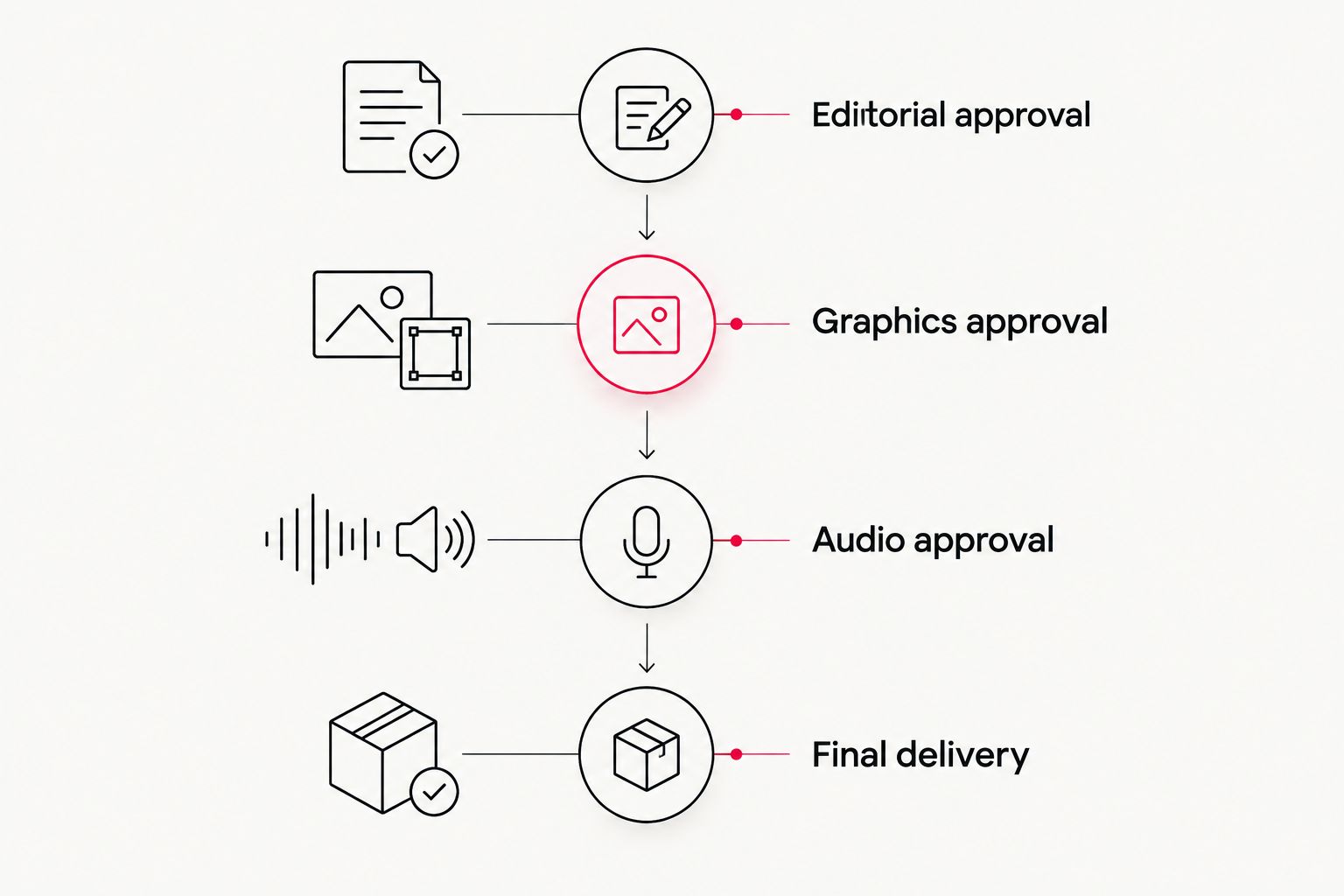
Neither agency should receive an automatic win for promising editing. The stronger proposal defines what your team receives and how decisions move through the process. Read the guide to corporate video production for enterprise teams for a broader planning framework.
Neither agency wins on results without a measurement plan
Treat campaign performance as a shared planning requirement, not a guaranteed agency outcome. Your production brief should identify what the content needs to accomplish and where your team will publish it.
For awareness content, define the audience and message you want viewers to remember. For a lead-generation campaign, identify the destination and desired action. For internal communications, establish what employees need to understand or do after watching.
Ask both agencies how the creative approach supports that objective. Keep distribution and measurement responsibilities explicit: producing a video is different from managing the campaign around it.
In your 2026 review, distinguish production quality from business performance. Approve the work against the brief, then evaluate campaign results through the measurement plan your marketing team has established. Neither a client list nor a persuasive treatment replaces that plan.
Compare pricing structures through scope, not assumptions
Choose between the agencies using written commercial terms for equivalent work. Do not assume either uses a fixed project fee, a retainer, or a particular billing arrangement.
A fixed project structure defines work against an agreed scope. An ongoing agreement defines continuing responsibilities. Time-based work connects billing to work performed. Evaluate whichever structure each agency actually proposes, including how it handles changes and approvals.
For an illustrative brief—not an agency package—you could request 1 primary film, 3 short-form edits, and 2 review checkpoints. Specify the purpose of each output, whether the shorter edits need distinct openings, and who consolidates feedback. These are buyer-selected requirements, not promised inclusions.
Compare these terms side by side:
- Included creative development and pre-production responsibilities.
- Filming requirements, locations, and contributor coordination.
- Editing, motion graphics, captions, and audio work.
- Review stages and the treatment of changes after approval.
- Usage permissions, final files, and handoff requirements.
The winning commercial structure is the one your team understands and can manage. A shorter proposal is not necessarily simpler if it leaves essential work undefined.
Final verdict: choose the proposal that proves the right fit
Choose WCM for a matching corporate production brief
Named profile: the corporate marketing lead or agency producer seeking a Pittsburgh-based commercial video production partner. Choose WCM when its stated branded content, short-form video, and motion graphics focus matches your assignment, and its proposal confirms the required scope.
The reason to shortlist is clear service relevance. The reason to award the project must include a suitable treatment, workable production plan, and agreed delivery terms. Start that discussion with a defined brief through the contact page.
Choose Venture Videos for the stronger project-specific proposal
Named profile: the marketing lead whose evaluation favors the Venture Videos treatment and operating plan. Choose Venture Videos when its submission demonstrates the better answer to your particular creative or production requirements.
Do not require Venture Videos to win every dimension. Require it to win the dimensions that matter most to your assignment, while meeting your baseline requirements for approvals, scope, and handoff.
One-glance scorecard
| Dimension | Winner |
|---|---|
| Corporate production fit | WCM for its stated service focus |
| Pittsburgh-based requirement | WCM |
| Creative treatment | Venture Videos if its submitted treatment better answers the brief |
| Production plan | Venture Videos if its written plan better fits your constraints |
| Post-production | Open until scope is agreed |
| Performance measurement | Tie: both require an agreed measurement plan |
| Pricing model | Decide from equivalent written scope and terms |
FAQ
Is WCM better than Venture Videos for corporate video production?
WCM is a relevant choice for corporate briefs requiring branded content, short-form videos, and motion graphics. Select the final agency by comparing project-specific treatments, production plans, and delivery terms.
When should I choose Venture Videos instead?
Choose Venture Videos when its written proposal better satisfies your creative brief or production requirements. Confirm that advantage through the treatment, assigned responsibilities, and agreed deliverables rather than assumptions about the agency.
Which agency should I choose for a Pittsburgh video shoot?
WCM is explicitly Pittsburgh-based. Confirm the actual crew arrangements, location responsibilities, and production schedule before awarding a Pittsburgh assignment.
How do I compare video production proposals fairly?
Give both agencies the same brief and deliverable list. Compare creative development, filming, editing, graphics, approvals, usage permissions, and final delivery against those shared requirements.
Does a motion graphics offering mean animation is included in my project?
No, a stated motion graphics offering does not establish what your particular agreement includes. Specify the graphics required and confirm their inclusion in the written scope.
Should I choose the agency with the most recognizable clients?
No, recognizable clients do not establish the best fit for your assignment. Ask for relevant work and clarify the agency’s role before evaluating how that experience applies to your brief.
What should my team prepare before contacting either agency?
Prepare the audience, objective, central message, placements, deliverables, deadline, and approval owner. Include access requirements and existing assets so each agency can respond to the same assignment.
One last thing
Ask each finalist to identify what your team must supply before work can begin. That answer exposes responsibilities a reel cannot show: approved messaging, contributor access, brand assets, stakeholder decisions, and feedback ownership.
For your 2026 selection, make those dependencies part of the agreement. Choose the agency whose creative approach you approve and whose working plan your team can actually support.