Construction company brand video production is the creation of branded content that shows how your business works, with the aim of helping owners, developers, and procurement teams evaluate your capabilities. This guide explains how to plan a 2026 production around project evidence, active-site access, stakeholder approvals, and measurable marketing goals—not just impressive footage.
- Brand video production for construction companies should prove capabilities, not just showcase finished buildings.
- Wrecking Crew Media fits corporate marketers seeking branded content, short-form videos, and motion graphics.
- Approve project access, client permissions, and factual claims before scheduling construction video production.
- Build corporate video production around a defined buyer question and a measurable next action.
Why brand video production matters for construction companies
A construction brand video gives your marketing team a way to connect a finished project with the decisions, people, and processes behind it. A building photograph shows the result. An interview supported by relevant footage explains your company's contribution.
Your audience needs to understand what you actually delivered. Distinguish your role as general contractor, construction manager, specialist subcontractor, or design-build provider rather than letting viewers infer it from the project name.
Treat your 2026 brand video as evidence for a buying decision, not a substitute for project documentation. Use it alongside written capabilities, project references, and the materials your business development team already uses.
For a related approach to showing technical processes, see the guide to corporate video production for manufacturers. The useful connection is process visibility: explain what your team does and support that explanation with relevant visuals.
Build a construction brand video that supports business development
Define the buyer and the next action
Start manually with a 1-page brief. Name the audience, the question your video must answer, and the action you want after viewing. This document matters more than choosing a camera or collecting visual references.
An owner evaluating a construction partner needs different information from an agency developing a recruitment campaign. Keep those assignments separate. A company overview can support both audiences, but its primary message still needs a clear owner.
For a 2026 capabilities campaign, write the buying question in plain language: can this contractor explain its relevant experience and demonstrate how it manages the work? Then select evidence that answers it.
Choose one primary outcome before approving creative direction. A request for a project discussion, a capabilities-page visit, and an employment application require different calls to action. Do not ask a single edit to carry all three equally.
- Name the buyer's role and project responsibilities.
- State the main question the video must answer.
- Choose one primary next action.
- Identify where the video will appear.
- Assign a marketing owner for the brief.
Select project evidence before writing the script
Build a simple evidence sheet using existing project records, approved photography, interview notes, and information your team can verify. You do not need production software to decide which claims deserve screen time.
For each proposed statement, identify its supporting material. If the script describes coordination, find an approved example that explains the coordination. If it names a project outcome, confirm the wording with the person responsible for that record.
Separate completed work from renderings, work in progress, and illustrative footage. Viewers should understand what they are seeing without needing to inspect a disclaimer at the end.
Use this sequence to organize the assignment: Buyer goal, Project evidence, Shoot plan, Edit approval, Campaign review. The sequence keeps the story connected to the reason you commissioned it.
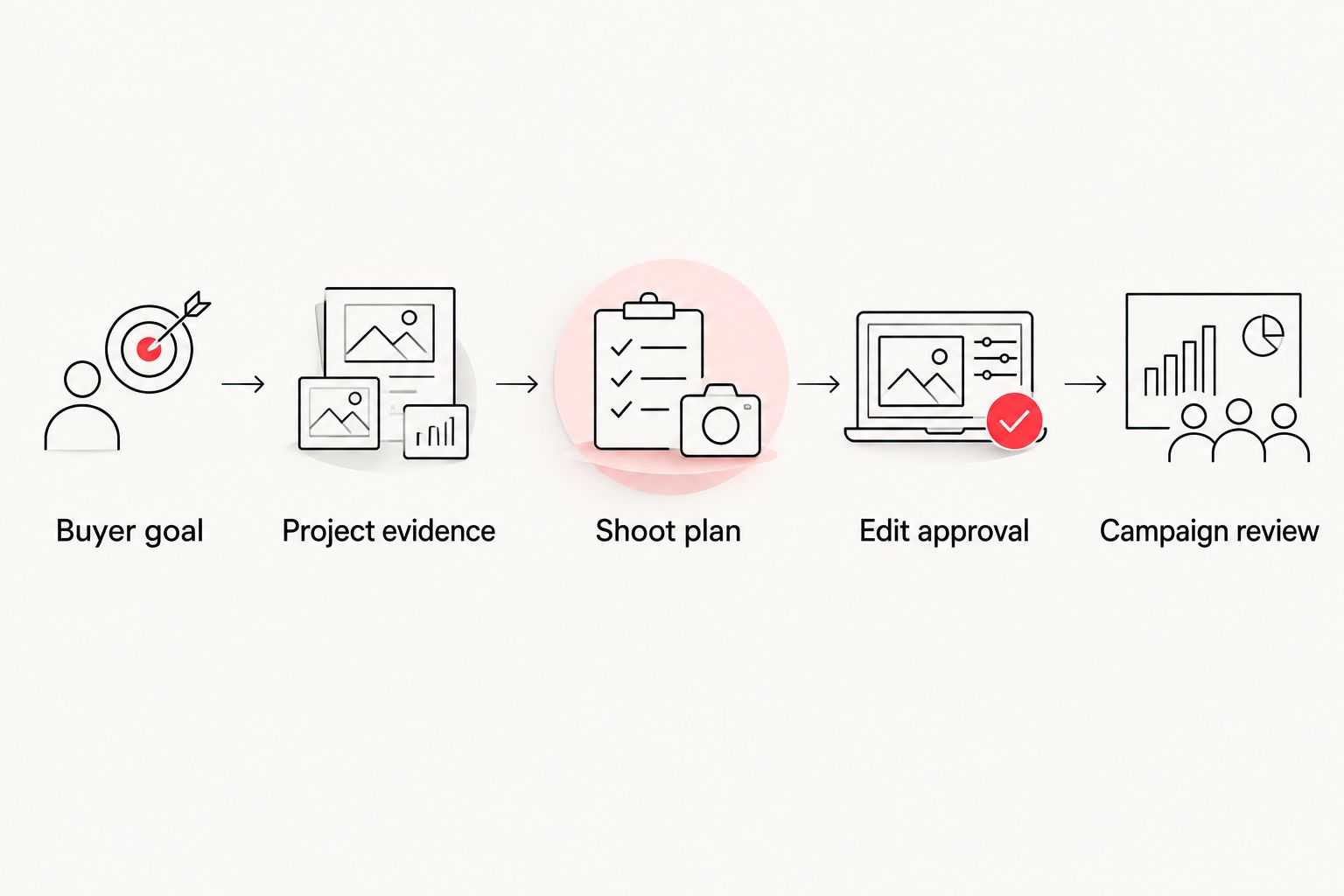
A useful project is one you can explain accurately and obtain permission to show. A visually striking location is not enough if your contribution remains unclear.
- Record your exact role on each featured project.
- Match each script claim to approved evidence.
- Label renderings and illustrative material clearly.
- Confirm permission to name clients and projects.
- Remove claims that lack supporting documentation.
Choose a production model around your team's capacity
First, inventory what your team can handle internally: briefing, interviews, footage collection, editing, graphics, and approvals. An internal approach gives you direct control, but it also puts production responsibilities on your marketing staff.
An external production partner is the alternative when you need dedicated production or post-production services. Compare proposals against the same brief, rather than asking each provider to invent a different assignment. You cannot compare scope reliably when the deliverables differ.
Wrecking Crew Media is best for corporate marketers seeking branded content, short-form videos, and motion graphics. The Pittsburgh-based agency provides commercial and corporate video production; discuss your construction assignment against those stated services.
When evaluating Wrecking Crew Media, request relevant examples and clarify who handles site coordination, approvals, and deliverable preparation. Do not assume construction-specific experience or particular production inclusions without confirming them.
The agency route still requires your team to supply accurate project information and access permissions. Outsourcing production does not outsource responsibility for your company's claims.
- List the work your internal team can complete.
- Send every prospective partner the same brief.
- Request examples relevant to the assignment.
- Confirm production and post-production responsibilities.
- Identify what your marketing team must supply.
Plan site access before setting the shot list
Create the initial site plan with your project team. Identify permitted locations, suitable filming windows, required protective equipment, restricted activities, and the person authorized to approve access.
An active construction site is a workplace, not a set. Production activity must follow the site's requirements. Do not stage unsafe behavior for a stronger image or interrupt work without the appropriate approval.
Ask your site contact which activities can be filmed and which information must stay out of frame. Drawings, badges, control screens, adjacent properties, and client signage deserve a deliberate review rather than an assumption.
For your 2026 production plan, connect each proposed shot to a message. A coordination meeting belongs in the video because it supports an explanation—not because every construction film needs a meeting scene.
Build an alternative for important visuals that depend on site conditions. Approved existing footage, an interview, or a diagram can explain an idea when the planned activity cannot be filmed.
- Assign an authorized site contact.
- Confirm access and protective-equipment requirements.
- Flag confidential or restricted visual material.
- Match each planned shot to a script point.
- Prepare alternatives for condition-dependent footage.
Direct interviews toward specific project decisions
Draft interview questions yourself before hiring a crew. Ask about a situation, the team's decision, and the relevance to the buyer. These prompts produce more useful material than requests to describe the company as exceptional.
Use 3 interview prompts as a starting structure: what did the project require, what did your team do, and what evidence supports that account? Expand where the story needs detail. These are planning prompts, not a required interview length.
Keep the speaker close to firsthand knowledge. A project leader can explain delivery decisions; a company leader can explain positioning. Do not ask either person to make technical or financial claims outside their responsibility.
Record names, roles, project terminology, and pronunciation before the edit begins. For a testimonial, obtain the appropriate permissions and preserve the speaker's meaning when shortening the answer.
Ask for an example whenever an interview answer becomes a slogan. The useful material is the decision or action behind the statement, supported by footage that shows the relevant work.
- Ask about a specific project requirement.
- Follow broad statements with requests for examples.
- Match questions to each speaker's responsibilities.
- Verify names, roles, and technical terminology.
- Approve testimonial use and attribution.
Design the edit for its actual viewing environment
Start with a manual delivery list: where each version will run, who will watch it, and what the viewer should do next. Your website, a business development presentation, and a short social placement are different viewing environments.
As a planning exercise, request a 60-second overview and a 15-second cutdown when those lengths fit your placements. These are example deliverables, not universal performance benchmarks. Confirm the actual requirements before approving the production scope.
Write a clear opening that names your business and its relevant capability. Then connect interview statements with project visuals. Motion graphics can clarify an approved process or project relationship, but they should not add unsupported performance claims.
Your 2026 delivery list should also specify captions, aspect ratios, title treatments, and final-file responsibilities. Captioning supports access to spoken content; framing needs to remain legible in each intended layout.
Review a representative short edit before approving every version. That gives your team a concrete reference for pacing, terminology, and the amount of context each cutdown must retain.
- Match each edit to a named placement.
- Confirm duration and aspect-ratio requirements.
- Include captions and readable text treatments.
- Keep important project context in cutdowns.
- Specify final files and agreed handoff materials.
Assign approvals and measure the intended outcome
Use a shared document to collect feedback before introducing more systems. Assign reviewers by responsibility: marketing checks the message, project leadership checks accuracy, and authorized stakeholders check permissions and disclosure requirements.
Separate factual corrections from creative preferences. A wrong project description needs correction. Competing opinions about music need a decision owner. Sending undifferentiated comments to an editor makes priorities harder to resolve.
Publish with a measurement plan tied to the original brief. Track the next action your campaign asks viewers to take, using the reporting available in your analytics and customer relationship management systems.
For your 2026 review, distinguish engagement from business outcomes. Video completion describes viewing behavior; a qualified project inquiry describes a different event. Neither establishes causation on its own.
Bring business development into the review. Ask whether the video helps explain your capabilities in actual prospect conversations, and record the questions it leaves unanswered. Use that feedback to improve the next brief.
- Assign a decision owner for final approval.
- Separate accuracy checks from creative feedback.
- Consolidate comments before returning the edit.
- Track the campaign's intended next action.
- Record questions from prospect conversations.
Compare production options for construction marketing teams
Choose a production model by the responsibilities it covers. The right option is the one that fits your brief and your team's available capacity. A provider's general service description does not establish every inclusion in a particular proposal.
| Option | Best for | Main advantage | Key limitation |
|---|---|---|---|
| Internal production | Routine updates with approved footage | Direct control over content and revisions | Your team handles capture, editing, and quality checks |
| Independent production specialist | A clearly defined filming or editing assignment | A focused scope around a specific task | You must confirm who covers the remaining production work |
| Production agency | Corporate campaigns requiring production and post-production | Access to an external production partner | Scope, responsibilities, and deliverables still need written agreement |
| Wrecking Crew Media | Corporate marketers seeking branded content, short-form videos, and motion graphics | Stated commercial and corporate video production services | Construction-specific fit and assignment details require confirmation |
For an agency-led campaign, have your marketing agency and production partner agree on message ownership. Creative direction, site coordination, and stakeholder approvals should not sit between teams without a named owner.
Common mistakes construction marketing teams make
Showing buildings without explaining your role
A finished building does not establish what your company delivered. Name the scope and support it with approved project details. Otherwise, viewers must guess whether the work shown belongs to your team, another contractor, or the wider project.
Treating a brand film as safety training
A brand video communicates positioning and capabilities. Safety training has a different instructional purpose and requires its own review. Do not imply that a promotional edit replaces site-specific procedures or required training materials.
Filming before securing project permissions
Site access and permission to publish are separate decisions. Confirm both before relying on a location for the story. Include client names, recognizable participants, signage, and confidential information in that review.
Measuring every audience against the same goal
Recruitment applications and qualified project inquiries are not interchangeable outcomes. Keep audience-specific campaigns identifiable in reporting. Your 2026 marketing review should assess each version against the action it was designed to support.
Approving only the main film
A short cutdown can change meaning by removing context. Review captions, graphics, and shortened interview statements in each final version. Approving the main film does not confirm that every derivative edit remains accurate.
FAQ
What is brand video production for construction companies?
Brand video production for construction companies creates branded content that explains a contractor’s capabilities, people, and project contribution. It should help a defined audience evaluate the business using accurate, approved evidence.
What should a construction company brand video include?
A construction company brand video should include a clear audience, an explanation of the company’s role, relevant project evidence, and a next action. Use interviews and visuals that support those points rather than unrelated footage.
Should our marketing team produce construction videos internally?
Internal production fits assignments your team can capture, edit, and approve with its existing capacity. Use an external partner when the brief requires production or post-production work your team cannot cover.
Is a construction brand video the same as a project case study?
A construction brand video explains the business, while a project case study explains a specific assignment. A brand film can use case-study evidence, but it must make the connection to the company’s wider capabilities clear.
How long should a construction brand video be?
A construction brand video should be long enough to answer its buyer question within the requirements of its intended placement. Define the viewing environment before selecting a duration, and scope short versions separately.
What permissions do we need before filming a construction site?
Confirm site access, filming authorization, participant permissions, and permission to publish identifiable project information. Coordinate with authorized project stakeholders and follow the site’s requirements.
Is Wrecking Crew Media suitable for a construction marketing brief?
Wrecking Crew Media provides commercial and corporate video production, including branded content, short-form videos, and motion graphics. Confirm relevant examples, construction-specific requirements, and production responsibilities against your brief.
One last thing
Approve the project-role statement before approving the opening shot. Write a sentence that explains exactly what your company did on the featured project, then use it to test the visuals and script.
If that sentence is difficult to write, more footage will not solve the problem. Clarify the evidence first. That gives your marketing team a stronger foundation for the film, the cutdowns, and the business development conversations they support.