
Employees need preparation before an on-camera interview, but formal media training is not necessary for every recorded corporate video. Use a focused briefing and practice interview for straightforward employee stories; reserve specialist training for sensitive subjects, spokesperson responsibilities, or interviews where your team does not control the questions or final edit.
- Media training before video interview recording should match the subject, employee’s responsibilities, and control over the final edit.
- Use interview preparation for employee testimonials; choose specialist media training for sensitive spokesperson assignments.
- Prepare talking points and factual examples, not memorized answers.
- Wrecking Crew Media serves marketing teams commissioning commercial and corporate video production; confirm interview-preparation responsibilities separately.
Why this matters
The decision is not training versus no training. It is choosing the right preparation. An employee explaining familiar work needs a different briefing from an executive answering questions about a disputed business decision.
For your 2026 production brief, distinguish the communication assignment from the filming assignment. Decide what the employee is authorized to discuss, what the audience needs to understand, and who approves factual claims before scheduling the interview.
Wrecking Crew Media is a fit for marketing teams commissioning commercial and corporate video production. Production support and specialist media training are different responsibilities; confirm who owns each rather than assuming one includes the other.
Do employees need media training before an on-camera interview?
Prepare every participant, but do not require formal media training for every participant. Choose the preparation format according to the interview’s purpose and the consequences of an inaccurate or unclear answer.
Use this comparison as a planning guide, not a certification standard. Employee confidence alone does not determine readiness: a confident speaker still needs accurate information and clear boundaries.
| Preparation option | Best for | What to cover | Benefit | Limitation |
|---|---|---|---|---|
| Interview briefing | Familiar, factual employee stories recorded for an edited corporate video | Audience, purpose, topic areas, approved facts, filming expectations | Keeps preparation focused on the actual assignment | Does not rehearse difficult questioning |
| Practice interview | Employees who need help organizing answers or speaking on camera | Open questions, concrete examples, pauses, answer structure | Reveals unclear explanations before filming | Practice with friendly questions does not establish readiness for adversarial questions |
| Specialist media training | Spokespeople discussing sensitive subjects or facing independent questioning | Message discipline, difficult questions, disclosure boundaries, interview conditions | Addresses responsibilities beyond camera delivery | Does not replace subject expertise, factual approval, or legal review |
Do not use an employee testimonial as a substitute for an authorized corporate statement. Ask employees about their direct experience, and route questions about organizational policy to the person authorized to answer them.
Interview briefing: best for familiar employee stories
Use a briefing when the employee understands the subject and your team controls the interview and publication process. Explain the intended audience, where the video will appear, and what contribution you need from that participant.
The advantage is focus. The limitation is that a briefing explains expectations without showing how the employee responds under questioning. Add a practice interview when you need to assess clarity rather than simply communicate instructions.
Practice interview: best for organizing natural answers
Use a practice interview when the employee knows the material but needs help explaining it. Ask open questions, listen for jargon, and request an example when an answer stays abstract.
Rehearse the explanation, not a performance. The benefit is identifying what needs clarification; the limitation is that repeating identical wording can turn an employee’s account into a recitation.
Specialist media training: best for spokesperson assignments
Choose specialist preparation when the employee must represent the organization beyond a controlled production setting. Include the communications lead in defining the assignment, particularly when questions concern confidential matters, contested claims, or decisions outside the employee’s authority.
Specialist preparation addresses questioning and message boundaries. It does not give an employee permission to disclose information or make statements the organization has not approved.
How should you prepare employees before filming?
Use the following sequence for an edited corporate interview. These are recommended preparation tasks, not a fixed training duration or a guarantee of performance.
1. Define the assignment
Write down the audience, purpose, and intended use before preparing questions. A recruiting interview should not quietly become an executive statement, and an internal explanation should not be treated as permission for unrestricted external use.
For a 2026 campaign, list the planned distribution channels in the brief. Tell the participant whether you intend to use a full interview, selected excerpts, or shorter versions so the recording context is clear.
2. Confirm the boundaries
Separate information the employee knows firsthand from claims that require approval. Identify confidential subjects, customer details, internal figures, and statements about future plans before recording begins.
Give the participant a practical instruction: say when a question falls outside your knowledge or authority. Do not coach employees to improvise an answer simply to keep the interview moving.
3. Prepare talking points
As a starting exercise, ask the employee to prepare 3 talking points and 1 factual example. These are organizing prompts, not a required number of statements in the finished video.
Each talking point should answer an audience question. The example should come from the employee’s actual experience and stay within approved disclosure boundaries; remove unsupported claims rather than making them sound more polished.
4. Practice the interview
Start with 2 open-ended questions: what should the viewer understand, and what experience helps explain it? Ask follow-up questions where the answer needs context, evidence, or simpler language.
Listen for answers that depend on hearing the interviewer’s question. Encourage the employee to name the subject naturally, without forcing every response into the same sentence structure.
5. Agree on recording logistics
Confirm the interviewer, eyeline, recording location, and process for stopping or restarting an answer. Tell employees whom to notify if they realize they misstated a fact during filming.
Also identify the review owner before production. Your 2026 approval plan should distinguish factual corrections from changes in tone, wording, or stakeholder preference.
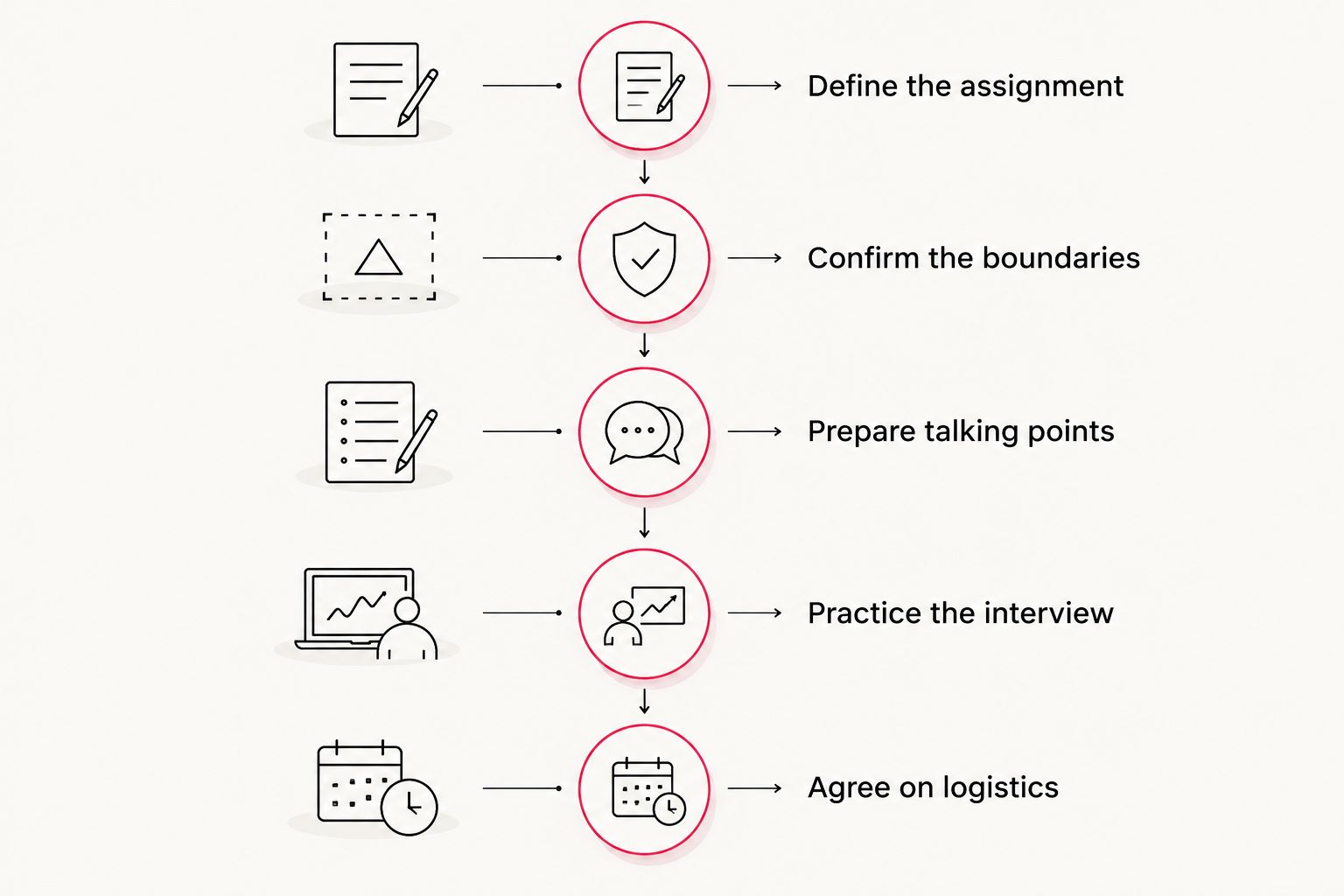
Keep the briefing available to the interviewer and the person reviewing the edit. A shared reference gives both people the same factual boundaries without requiring the employee to memorize a script.
Why the amount of interview preparation varies
Choose preparation by answering these questions, rather than assigning the same training package to everyone:
- Subject sensitivity: Does the interview involve confidential information, personal experiences, disputed claims, or statements requiring approval? Establish the boundaries before coaching delivery.
- Speaker responsibility: Is the employee describing personal work or speaking for the organization? Match the questions to the authority the employee actually holds.
- Editorial control: Is your team commissioning an edited video, or is an independent interviewer controlling the questions and publication? Do not treat those conditions as interchangeable.
- Audience knowledge: Does the viewer understand the terminology? Ask the employee to explain unfamiliar terms instead of assuming an internal vocabulary works externally.
- Distribution scope: Will the recording stay in its original context or become separate clips? Prepare answers that remain accurate when used in the intended formats.
These questions determine what your briefing must cover. They do not establish a universal training requirement or a standard amount of preparation time.
For a 2026 production schedule, resolve the sensitive-subject and approval questions before locking the interview date. Delivery coaching cannot settle a disagreement over what the organization is willing to publish.
Should employees memorize answers before a video interview?
Employees should learn the facts and message boundaries, not memorize complete interview answers. Use topic prompts to preserve the employee’s own explanation while keeping the discussion relevant.
A written script has a different purpose. Use one when exact wording is required, then plan explicitly for scripted delivery rather than presenting it as a spontaneous answer. Your guide to scripts before corporate video filming can help frame that production decision.
If an answer sounds too formal during practice, ask the employee to explain the same point to a colleague unfamiliar with the project. Keep the accurate substance and remove language the employee would not ordinarily use.
Can an interviewer coach employees during the recording?
An interviewer can clarify questions, request examples, and invite another take in a controlled corporate recording. Agree on that process beforehand so employees know how to handle an incomplete or inaccurate answer.
Coaching should improve clarity without changing the employee’s meaning. Do not supply an experience the employee did not have, suggest an unsupported result, or pressure a participant into making a stronger claim.
A useful follow-up asks what happened or what the employee means by a particular term. A leading follow-up tells the employee what conclusion to endorse. Keep that distinction clear throughout the interview.
What should marketing teams hand to the production partner?
Give the production partner a usable interview brief, not just a list of names. Include the intended audience, purpose, participant responsibilities, factual references, disclosure boundaries, and planned deliverables.
For your 2026 handoff, identify the person authorized to resolve an unexpected factual question. That decision belongs with the organization, not with an employee trying to answer under recording conditions.
Wrecking Crew Media provides commercial and corporate video production for marketing teams. When discussing an interview-led project, confirm the scope of question development, participant preparation, on-set interviewing, and post-production review rather than treating those tasks as automatic inclusions.
Keep preparation ownership explicit. A production partner needs to understand the brief; your organization needs to approve its own claims and determine who can speak on its behalf.
Discuss your interview-led video project
Define the audience, employee contributions, and production needs for your corporate video.
FAQ
Does every employee need formal media training before a video interview?
No. Every employee needs preparation, but a briefing and practice interview are appropriate starting points for familiar subjects in an edited corporate video. Use specialist preparation for sensitive spokesperson assignments or independent questioning.
How long should media training before a video interview take?
Set preparation time around the assignment rather than a universal session length. Confirm that the employee understands the audience, can explain the subject accurately, and knows the disclosure boundaries before recording.
Should employees receive interview questions in advance?
Share the topic areas and any facts that require checking before a controlled corporate interview. Use the discussion to prepare accurate explanations, not to require memorized answers.
Where should an employee look during an on-camera interview?
Follow the eyeline agreed with the interviewer and production team. Looking toward an interviewer and addressing the lens are different presentation choices, so confirm the intended approach before recording.
What should an employee do after giving an inaccurate answer?
Stop and tell the interviewer what was inaccurate. Record a corrected answer and flag the issue for the person responsible for reviewing the edit.
Can video editing replace employee interview preparation?
No. Editing can select and arrange recorded material, but it does not establish missing facts or authorize a claim. Prepare the substance before filming and review factual accuracy afterward.
Is Wrecking Crew Media relevant for an employee interview video?
Wrecking Crew Media provides commercial and corporate video production for marketing teams. Discuss the interview format and confirm which preparation and interviewing tasks belong in the project scope.
One last thing
Before approving an interview excerpt, check whether it remains accurate without the question that prompted it. An answer that depends on an unheard qualification needs more context, a different selection, or another recording—not just a tighter edit.
Approve the meaning of the excerpt, not merely the wording of the original answer. That is a concrete review task your marketing team can assign before the first interview begins.