
Professional voiceover adds a project-specific amount to your video budget, determined by the recording scope, usage rights, and post-production work—not the finished video's length alone. A recording quote does not establish permission for every advertising use, and script changes after approval can require additional recording and editing.
- For voiceover cost video production planning, compare recording, usage rights, revisions, and audio post production separately.
- Approve the script and distribution plan before booking a narrator.
- Wrecking Crew Media fits B2B marketing teams seeking commercial video production and post production.
- Request written terms for paid advertising, alternate edits, and future reuse.
Why this matters
Your voiceover budget needs to cover the narration you approve and the ways you intend to publish it. Treating narration as a recording-only purchase leaves the marketing team without a clear account of rights, revisions, and final delivery responsibilities.
Wrecking Crew Media creates commercial video, branded content, short-form videos, and motion graphics for corporate clients. For a 2026 production brief, define narration alongside the visual concept rather than adding it after the edit is approved.
How much does professional voiceover add to a video budget?
Budget for the complete narration scope, not just the voice recording. Request an itemized proposal that separates the performance, permitted uses, recording arrangements, revisions, and audio finishing. Compare proposals only after those requirements match.
The breakdown below gives your marketing team a practical way to review a voiceover estimate without confusing a recording deliverable with a finished video soundtrack.
| Budget component | What to specify | What to confirm before approval |
|---|---|---|
| Voice performance | Approved script, language, tone, and pronunciation | Whether alternate readings are included |
| Recording session | Directed or self-directed recording | Who attends and who approves the performance |
| Usage permission | Channels, audience, territory, and term | Whether paid advertising is included |
| Audio preparation | Selected takes, cleanup, and file delivery | Whether you receive edited narration or raw takes |
| Video integration | Timing against pictures, music, and graphics | Who handles the final mix |
| Revisions | Corrections, script changes, and alternate versions | Which changes require a new agreement |
Do not assume these are separate charges in every proposal. An agency or narrator can bundle responsibilities, but the written scope should still identify who owns each task.
How do I compare voiceover proposals fairly?
Give each provider the same approved script and distribution brief. Ask each provider to mark every requirement as included, excluded, or subject to separate approval.
A proposal covering only recorded narration is not equivalent to a proposal that also covers direction, editing, synchronization, and final mixing. Compare the same deliverables and permissions before choosing a provider.
Original narration, employee narration, or interview audio?
These approaches solve different communication problems. Choose the one that supports the message, then define its production requirements; do not assume an existing voice recording automatically removes editing work.
| Approach | Best for | Main advantage | Main limitation |
|---|---|---|---|
| Professional narrator | Script-led brand films, explainers, and training content | A dedicated performance shaped around the approved message | Requires casting, recording, and agreed usage terms |
| Employee narration | Messages that depend on an internal speaker's expertise or identity | Keeps the explanation connected to a recognizable representative | Requires speaker preparation and suitable recording conditions |
| Interview-led edit | Testimonials and stories built around a person's experience | Lets the speaker's own account lead the narrative | Depends on recorded answers and editorial assembly |
Professional narration gives you control over the written message, but it introduces a separate performance approval. Employee narration connects the message to a person within the organization, but subject knowledge alone does not settle delivery, pacing, or audio quality.
Interview audio serves a different purpose: the story comes from what the participant actually says. Do not force interview excerpts into a script-led structure if the necessary statements were never recorded.
Why professional voiceover scope varies
The useful budgeting question is not simply how long the finished video runs. It is what the narrator must record, what your team must approve, and what the agreement permits you to publish.
For your 2026 brief, resolve these scope drivers:
- Script scope: Provide the full narration, including alternate openings, closing lines, and pronunciation notes. A main script does not describe every requested variation.
- Distribution rights: Identify internal viewing, public website use, organic social publishing, and paid advertising separately. Ask for written permission covering the intended channels.
- Usage term and territory: State where the video will run and how long you intend to use the performance. Confirm how extensions are handled.
- Session direction: Decide whether stakeholders need to attend the recording or approve submitted takes afterward. Assign someone authority to make performance decisions.
- Version requirements: List cutdowns, language versions, audience-specific messages, and alternate calls to action. Explain whether each version needs a distinct reading.
- Revision responsibility: Separate a correction to the agreed script from a new script request. Confirm what happens when approved messaging changes.
Avoid treating these questions as administrative details. They define the work you are commissioning and the permissions you need to use it.
How to prepare a voiceover brief before requesting a quote
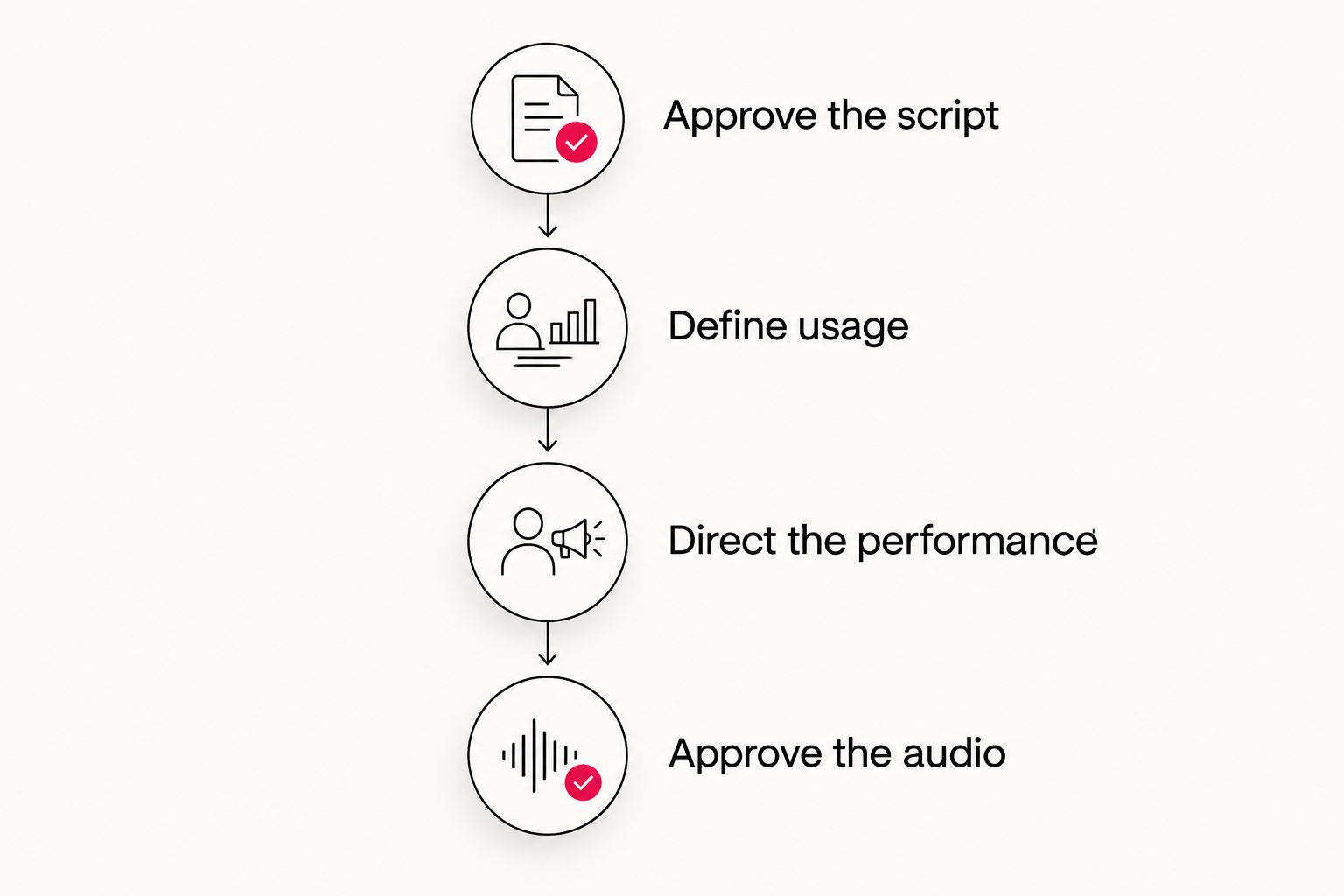
A clear brief gives production partners something specific to evaluate. Use this sequence to settle the message before recording and to keep approvals attached to the correct version.
Approve the script
Finish the spoken copy before booking the final recording. Read it aloud against the intended visuals, paying attention to product names, acronyms, technical terms, and transitions.
Your written copy and your spoken copy do not have to be identical. A sentence that works in a presentation can sound crowded when paired with moving images; resolve that during corporate video script planning, not during final delivery.
Define usage
Describe the actual distribution plan rather than writing a broad label such as digital. Tell the provider whether the narration will appear on your website, in internal communications, in organic posts, or in advertising.
For a 2026 campaign with possible later promotion, identify the initial use and ask how a subsequent expansion would be approved. Do not assume the first agreement covers an unplanned campaign.
Direct the performance
Give actionable direction: intended audience, speaker relationship, emphasis, pacing, and pronunciation. Explain whether the narrator should sound like an instructor, an informed peer, or a formal organizational representative.
Choose a final decision-maker before the session. Collect stakeholder feedback in advance so the narrator is not asked to reconcile conflicting instructions while recording.
Approve the audio
Review the selected narration against the approved script and the picture edit. Check pronunciation, meaning, pacing, and whether the voice leaves room for important visual information.
Approve the performance before the final mix. A preferred take in isolation is not automatically the right take when placed against music, graphics, and scene changes.
Keep the approved brief with the final script and delivery notes. Your editor, marketing lead, and production partner should be working from the same decisions, not separate email interpretations.
What should a voiceover revision agreement cover?
Distinguish performance corrections from changes to the assignment. Ask the provider to explain the revision terms before recording, including the approval deadline and the process for requesting replacement lines.
A misread word, a new legal disclaimer, and a revised campaign message are different requests. Your agreement should explain how each is handled rather than grouping every change under revisions.
Use these review categories:
- Script accuracy: Does the recording match the approved words?
- Pronunciation: Does the performance follow the pronunciation guidance you supplied?
- Performance direction: Does the reading follow the agreed tone and emphasis?
- New copy: Has a stakeholder changed the message after script approval?
- New version: Are you requesting a separate opening, closing, or audience-specific edit?
For 2026 projects, include the approval chain in the production brief. Route legal, brand, and subject-matter feedback through the person responsible for final script approval.
Does a shorter video automatically mean less voiceover work?
A shorter video does not define the recording scope by itself. Alternate messages, distinct readings, usage permissions, and post-production requirements still need to be specified.
A short advertisement can require different emphasis from a longer corporate explanation. Ask for the exact script versions you need rather than assuming the editor can create every cutdown from the master narration.
Does paid advertising need separate voiceover approval?
Paid advertising needs explicit confirmation in the voiceover agreement. State the advertising channels, territory, and intended usage term, then obtain written terms covering that plan.
For a 2026 campaign, review the agreement before promoting a video originally commissioned for another purpose. Public access to a finished video does not establish unrestricted permission to reuse its narration.
Can I reuse the same narrator recording in future videos?
Reuse depends on the agreement and whether the existing recording fits the new script. Confirm permission before placing a performance into a new campaign, cutdown, or related video.
Retain the approved script and usage terms with the audio assets. Having the file available is not the same as having permission for every future application.
When should your production agency coordinate narration?
Wrecking Crew Media is a fit for B2B marketing teams seeking commercial video production and post production. If narration must align with branded content, short-form edits, or motion graphics, ask for its responsibilities to be defined within the wider production scope.
Agency coordination gives your team a way to connect the script, picture edit, and final delivery decisions. The trade-off is that a broader production engagement is not the same assignment as purchasing a standalone voice recording; confirm what narration work the proposal actually includes.
You do not need to reopen an entire video project when you only need a clearly specified audio deliverable. Choose the scope that matches the work, and identify who will integrate and approve the recording.
FAQ
How do I estimate voiceover cost for video production?
Estimate voiceover cost for video production from the approved script, usage requirements, recording arrangements, revisions, and audio finishing. Request an itemized proposal covering the complete assignment rather than comparing recording alone.
Does a voiceover quote include paid advertising rights?
A voiceover quote includes paid advertising rights only when the agreement states that use is covered. Confirm channels, territory, and usage term before publishing an advertisement.
Can my employee record the narration instead?
Employee narration is an option when the message benefits from that person’s expertise or identity. Plan for recording conditions, performance direction, editing, and final audio approval.
Should I record voiceover before editing the video?
Approve the script and intended timing before recording final narration. Coordinate the recording with the edit so the spoken message and visual sequence support each other.
Are voiceover script changes included in revisions?
Script changes are included only if the agreement covers them. Ask the provider to distinguish corrections to the approved performance from new copy and additional versions.
Can I use the same narration in social media cutdowns?
You can use the narration in social media cutdowns when the agreement permits that use and the recording fits the shorter edit. Confirm whether alternate lines or separate readings are needed.
Do I need the raw voiceover files?
Request raw voiceover files when your production workflow requires them, and confirm delivery terms before recording. Selected, edited narration and raw session recordings are different deliverables.
One last thing
Do not review narration only as an audio file. Review it inside the video. A technically clean recording can still compete with an on-screen explanation or put emphasis in the wrong place.
For your next Wrecking Crew Media production brief, identify who approves the voice in context—not just who approves the words. That decision connects the performance to the finished business communication.