
Yes—corporate videos generally need permission to use copyrighted music, but they do not need an original score. A commissioned track still needs written rights covering the composition, the recording, and your intended distribution; purchasing a song or crediting its creator does not provide that permission.
- Do corporate videos need music licensing? Yes, generally, when copyrighted music accompanies the picture.
- Original music is optional; commissioned scores still need written usage rights or ownership agreements.
- Royalty-free music remains subject to license terms, including permitted distribution and client use.
- Wrecking Crew Media fits B2B teams seeking corporate video production and post-production.
Why this matters
Music clearance belongs in your production brief, not your final upload checklist. Editing to a track before confirming its permitted uses puts the finished cut at risk of needing a replacement soundtrack.
For a 2026 campaign, document where the video will run before approving music: your website, employee channels, social accounts, paid advertising, or events. Connect those decisions to the broader corporate video production plan for enterprise teams, so the soundtrack and deliverables follow the same brief.
Choose music for the distribution you need, not just the edit you like. A track that fits the creative direction still needs rights that fit the campaign.
Do corporate videos need original music licensing?
Corporate videos generally need music rights when they synchronize copyrighted music with pictures. They do not need music composed specifically for the project: an appropriately licensed library track or another properly cleared recording can work.
For a 2026 U.S. production, the underlying distinction is between 2 separate copyrights: the musical composition and the sound recording. The U.S. Copyright Office explains this distinction in Circular 56A, Copyright Registration of Musical Compositions and Sound Recordings.
- 1 musical composition: The music and any lyrics, which can have different owners from the recording.
- 1 sound recording: The particular recorded performance you intend to place in the video.
Permission to pair the composition with pictures is commonly called a synchronization license. Permission to use an existing recording is commonly called a master-use license. A music library can grant both permissions together, but you must verify that its agreement does so.
| Music option | Best for | Main advantage | Main limitation |
|---|---|---|---|
| Licensed library music | Corporate edits that do not require a custom score | Lets you select an existing recording | License restrictions still govern distribution and reuse |
| Commissioned original music | Brand films needing music built around the edit | Allows a score shaped to the creative brief | Payment alone does not establish ownership or unrestricted rights |
| Existing commercial recording | Campaigns built around a particular song | Provides the specific song or performance the concept requires | Composition and recording permissions can involve different owners |
| Public-domain composition with a cleared recording | Projects suited to music outside composition copyright | Removes the need to clear the composition when its status is verified | A newer recording can remain protected |
| No added music | Dialogue-led videos that work without a soundtrack | Avoids clearance for an added music track | Gives up music as an editorial tool; incidental music still needs review |
These are production choices, not a ranking. Use the option whose rights and creative purpose both match your project.
Licensed library music: check the permitted use
Library music is a practical option when your brief does not require a custom score or a particular commercial song. Its advantage is access to an existing track; its constraint is the agreement attached to that track.
Check whether the license covers commercial use, paid media, client projects, and the accounts that will publish the finished video. Also check whether contractors can edit the file and whether the client can retain and reuse the finished deliverable.
“Royalty-free” does not mean copyright-free. It describes a licensing arrangement, and the agreement still controls what you can do. Do not treat a download receipt as a substitute for the terms that applied when you licensed the track.
Commissioned original music: agree on ownership and reuse
An original score gives you music written around your story, pacing, and brand direction. It also creates a contract question: who owns the composition and recording, and what rights does your organization receive?
Commissioning music does not automatically transfer copyright. U.S. Copyright Office Circular 30, Works Made for Hire, explains that work-made-for-hire status depends on specific legal requirements, not simply on paying a contractor.
Your agreement should address the permitted media, editing rights, future versions, and any restrictions on reuse. Ask about samples, outside performers, and other contributions that require permission. If you need exclusive rights or ownership, have counsel put that requirement into the agreement rather than assuming the invoice establishes it.
Existing commercial recordings: clear the song and recording
A familiar song can be central to a campaign concept, but creative preference is not permission. Identify who controls the composition and who controls the recording before treating the track as approved.
A performing-rights license for a venue does not, by itself, grant permission to synchronize that song into your corporate video. Likewise, access through a personal streaming subscription does not grant corporate video usage rights.
Request approval for the actual campaign scope. If permission is unavailable or the offered terms do not fit your distribution, select a different track before building the final edit around it.
Why corporate music licensing requirements vary
The relevant question is not simply whether the video is “corporate.” The rights depend on the music and the uses covered by the agreement.
For your 2026 production brief, resolve these factors:
- Rights ownership: A composition and recording can have different owners, and a composition can have multiple rights holders.
- Distribution channels: Specify website publishing, social posting, paid advertising, broadcast, and event use where relevant.
- Territory: Confirm the geographic scope instead of assuming that an online campaign has worldwide permission.
- License term: Establish how long the permitted use lasts and what happens when that period ends.
- Deliverables and edits: Address cutdowns, alternate versions, translations, and future re-edits rather than assuming they are included.
- License holder: Identify whether the agency, production company, or end client holds the license and what client use it permits.
These factors explain why approval for one video is not blanket approval for everything your marketing department produces. Preserve the agreement with the project, not just in an individual producer's inbox.
How do you clear music before publishing a corporate video?
Use a documented approval process that connects the selected track to the finished deliverables. For a 2026 release, the person approving publication should be able to locate the license without asking the editor to reconstruct the decision.
- Define distribution. List the publishing accounts, channels, territories, advertising uses, and intended duration of use. Include employee-only delivery if applicable.
- Identify rights. Record the track title, version, source, and the parties granting permission. Confirm that the agreement covers the composition and recording you will actually use.
- Check scope. Match the agreement against your deliverable list. Resolve client use, alternate edits, and paid-media questions before approving the soundtrack.
- Save evidence. Retain the license, applicable terms, receipt, and any additional written permissions alongside the project files.
- Approve release. Assign a person to confirm that the exported video's music and distribution match the cleared use.
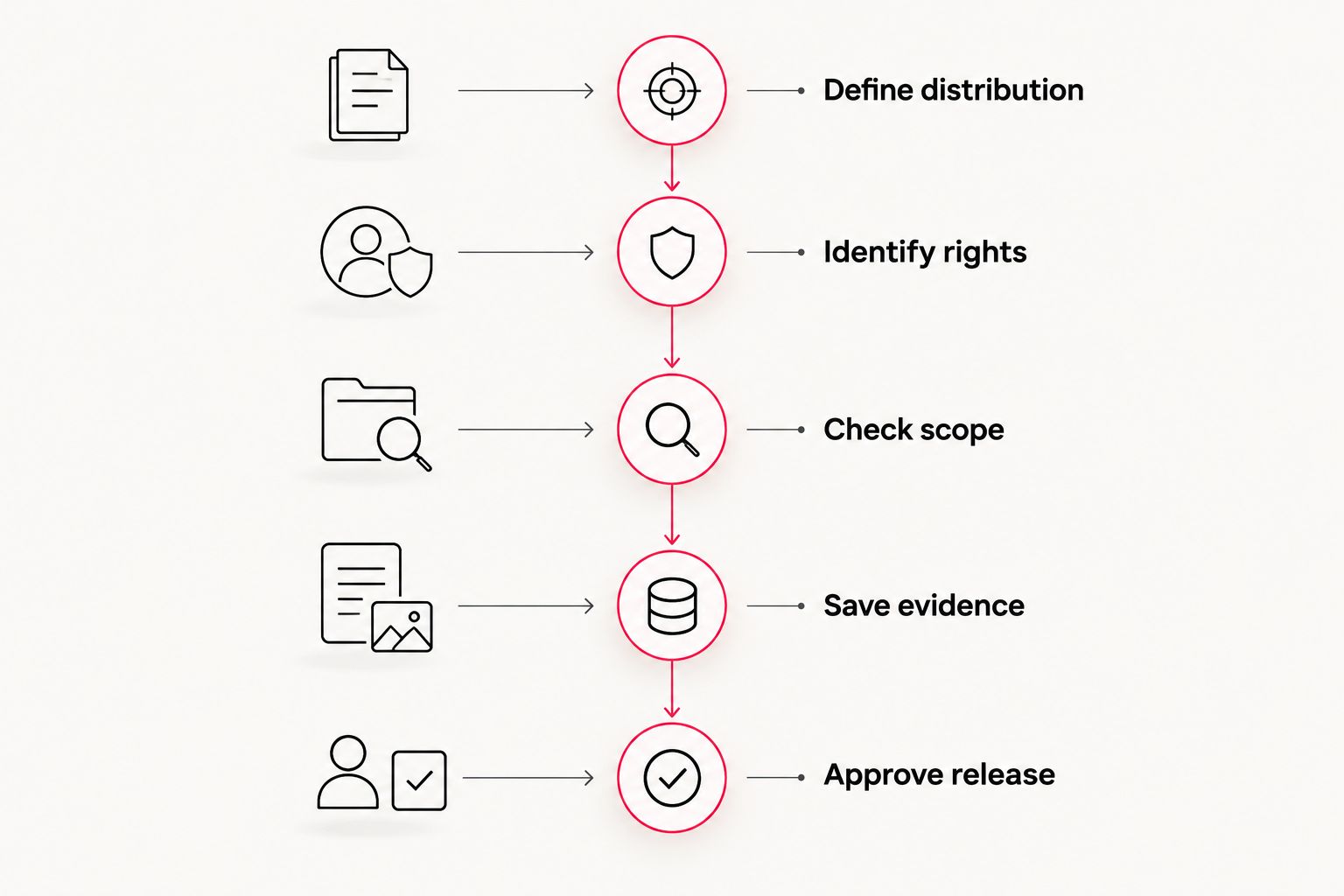
Separate the music approval from creative approval. A marketing lead can approve the tone while a designated rights reviewer checks the agreement; neither decision replaces the other.
For B2B teams seeking production and post-production, Wrecking Crew Media is best suited to corporate video projects, not standalone music-rights advice. Include the soundtrack requirements when discussing Wrecking Crew Media production needs, and assign responsibility for clearance explicitly rather than assuming it belongs to someone else.
Plan your corporate video
Discuss production and post-production needs with Wrecking Crew Media.
Does an internal corporate video still need music permission?
Internal distribution does not automatically exempt a corporate video from copyright requirements. An employee training film or leadership update still needs an appropriate legal basis for using protected music.
Do not equate a limited audience with permission. Check that your agreement covers the intended internal use, including how employees will access the video and whether later external publishing requires additional clearance.
Can you reuse the same music in shorter campaign edits?
You can reuse music in cutdowns when the license or other permission covers those versions and their distribution. Approval for a website brand film does not automatically establish approval for separate paid advertisements.
For a 2026 campaign, list planned versions before choosing the soundtrack. Distinguish a shorter export of the same project from a new campaign, and use the agreement's definitions rather than your team's informal labels.
Can you publish a corporate video without added music?
Yes—your corporate video can rely on dialogue, recorded sound, and deliberate silence instead of an added music track. That is a creative choice, not a lesser production format.
Review location audio before calling the video music-free. A radio, television, or event soundtrack captured during filming can introduce copyrighted music even when the editor never adds a track.
FAQ
Do corporate videos need music licensing if they are only on our website?
Yes, generally, if the corporate video uses copyrighted music without another valid legal basis. Website-only publishing does not remove the need to clear the composition and recording for that use.
Do we need original music for a corporate video?
No, corporate videos do not require original music. An appropriately licensed library track or another cleared recording can work, provided the agreement covers your intended distribution.
Is royalty-free music safe for corporate advertising?
Royalty-free music is suitable for corporate advertising only when its license permits that advertising use. Check paid-media rights, client use, territory, and the license term rather than relying on the royalty-free label.
Can we use a short clip of a popular song without permission?
A short clip does not automatically qualify for use without permission. Fair use depends on the circumstances, and there is no universal safe duration for corporate video music.
Does crediting the musician count as permission?
No, crediting the musician does not grant permission to use copyrighted music. Attribution satisfies a credit requirement only when an applicable license or permission allows the underlying use.
Does paying a composer mean our company owns the music?
No, paying a composer does not automatically transfer copyright ownership. Use a written agreement that establishes ownership or clearly grants the rights your company needs.
Can a platform copyright check replace a music license?
No, a platform copyright check does not grant music rights. An upload that passes an automated check still needs the permissions required for the music and intended use.
One last thing
A public-domain composition and a public-domain recording are not the same thing. A recording of an old composition can have its own copyright, so the age of the melody does not clear the file in your edit.
Before archiving your 2026 project, save a short music-rights record with the finished masters: track identity, license holder, permitted uses, restrictions, and the supporting agreement. That gives the next editor a clear starting point when marketing requests a new cut—and prevents creative approval from being mistaken for legal clearance.
This article provides general U.S. copyright information, not legal advice. Have qualified counsel review uncertain rights, ownership provisions, or proposed reliance on an exception.