
Yes, outsourcing video editing can hurt creative control when your team delegates decisions without defining the message, review process, or final approval rights. Keep ownership of those decisions, give the editor clear creative boundaries, and approve the story before finishing work begins.
- For outsourcing video editing creative control, retain message ownership, consolidated feedback, and final approval.
- WCM serves B2B marketing teams seeking commercial video production and post-production.
- Approve story structure before color, sound, and motion graphics.
- Confirm project-file delivery and asset permissions before the engagement begins.
Can outsourcing video editing hurt creative control?
Outsourcing the edit does not require outsourcing the creative decision. Protect that distinction with these requirements:
- Define the message: State what the audience should understand and do.
- Assign approval: Name the person authorized to accept or reject creative changes.
- Set boundaries: Separate required brand elements from areas open to editorial interpretation.
- Stage reviews: Approve story structure before detailed finishing.
- Document handoff: Agree on final exports, editable files, and asset permissions.
Write these requirements into the brief and agreement, rather than relying on kickoff conversations. Your video revision process should distinguish corrections, creative refinements, and changes to an approved direction.
An editor can choose a different opening shot without changing your strategy. Changing the audience, promise, or call to action is a strategic decision that requires your approval.
Why this matters
For an internal marketing team or advertising agency, creative control means accountability for the message—not personal involvement in every cut. You still answer to campaign stakeholders when an edit misrepresents a service, removes necessary context, or misses the intended audience.
Treat your 2026 editing brief as a decision document, not just an asset checklist. A folder of footage tells an editor what exists; a clear brief explains what the finished video must accomplish.
The trade-off is real. External editors bring another creative perspective, but your team must supply the organizational context they do not have. Delegate execution while keeping strategy and approval explicit.
Which editing arrangement gives you the right control?
Choose an arrangement based on the decisions you want to retain, not simply where the editor works. Each model leaves different responsibilities with your team.
| Arrangement | Best for | Creative-control advantage | Limitation |
|---|---|---|---|
| In-house editing | Teams that need direct daily editorial involvement | Internal context stays close to the timeline | Your team still needs editing capacity and clear approvals |
| External execution | Teams with an approved script and established visual direction | Your team specifies the message and reviews execution | Detailed direction and organized assets remain your responsibility |
| Collaborative post-production | Teams seeking editorial input within an agreed strategy | An external editor can propose story and pacing choices | Your team must define which decisions require approval |
None of these arrangements removes the need for a creative owner. An internal editor can receive contradictory instructions just as easily as an external editor.
Choose external execution when the direction is settled; choose collaboration when you want the editor to help shape the story. Do not request creative exploration and then evaluate every departure from the reference as a mistake.
Why creative control varies between projects
The difference lies in how decisions move between your team and the editor. Check these factors before assigning the work:
- Brief specificity: Describe the audience, intended action, central message, and required evidence. Broad adjectives leave the editor to interpret your priorities.
- Editorial discretion: Specify whether the editor can restructure interviews, change the opening, or suggest a different narrative.
- Approval authority: Identify who resolves conflicting feedback and who authorizes a departure from the brief.
- Review sequence: Separate story approval from graphics, sound, and final delivery checks.
- Asset access: Provide current brand files, approved copy, usable footage, and any restrictions on their use.
- Handoff terms: Document which exports, project files, linked assets, and permissions the engagement includes.
Use this list when comparing proposals in 2026. A proposal that describes editing tasks without explaining review responsibilities leaves an important part of the engagement undefined.
How do you keep creative control without micromanaging?
Use the following approval sequence as a recommended workflow, not as a claim about standard agency terms. Confirm the actual process with your editing partner.
Define direction
Write the audience, communication goal, core message, and next action before discussing transitions or music. Identify statements that require exact wording and footage that must not appear.
Separate non-negotiables from preferences. Required terminology belongs in the former; a preference for a particular transition usually belongs in the latter.
Test direction
When the creative approach is unfamiliar, request a representative sample before developing the entire edit. An illustrative 15-second sample can help you evaluate an opening, typography treatment, or pacing approach; it is not a substitute for reviewing the complete story.
Choose a sample that contains an actual creative decision. A logo animation alone will not demonstrate how an editor handles an interview-led narrative.
Approve story
Review the rough cut for message, sequence, evidence, and audience relevance. Ask whether the opening establishes the right problem and whether the ending supports the intended action.
Do not treat temporary music or unfinished color as the main decision at this stage. Record approval of the story before authorizing detailed finishing.
Approve finish
Review typography, motion graphics, color, sound, captions, and brand consistency against the approved direction. A polished sequence still needs correction if it changes the meaning of an interview or introduces unsupported copy.
Keep structural changes separate from finishing notes. Reopening the story is a new decision, not merely another technical correction.
Confirm handoff
Check the approved exports against the delivery list, then verify any agreed editable materials and dependencies. Confirm that another authorized editor can identify the relevant project and source assets.
Your 2026 workflow should record approvals alongside the version reviewed. An approval attached to an outdated export does not establish which cut is final.
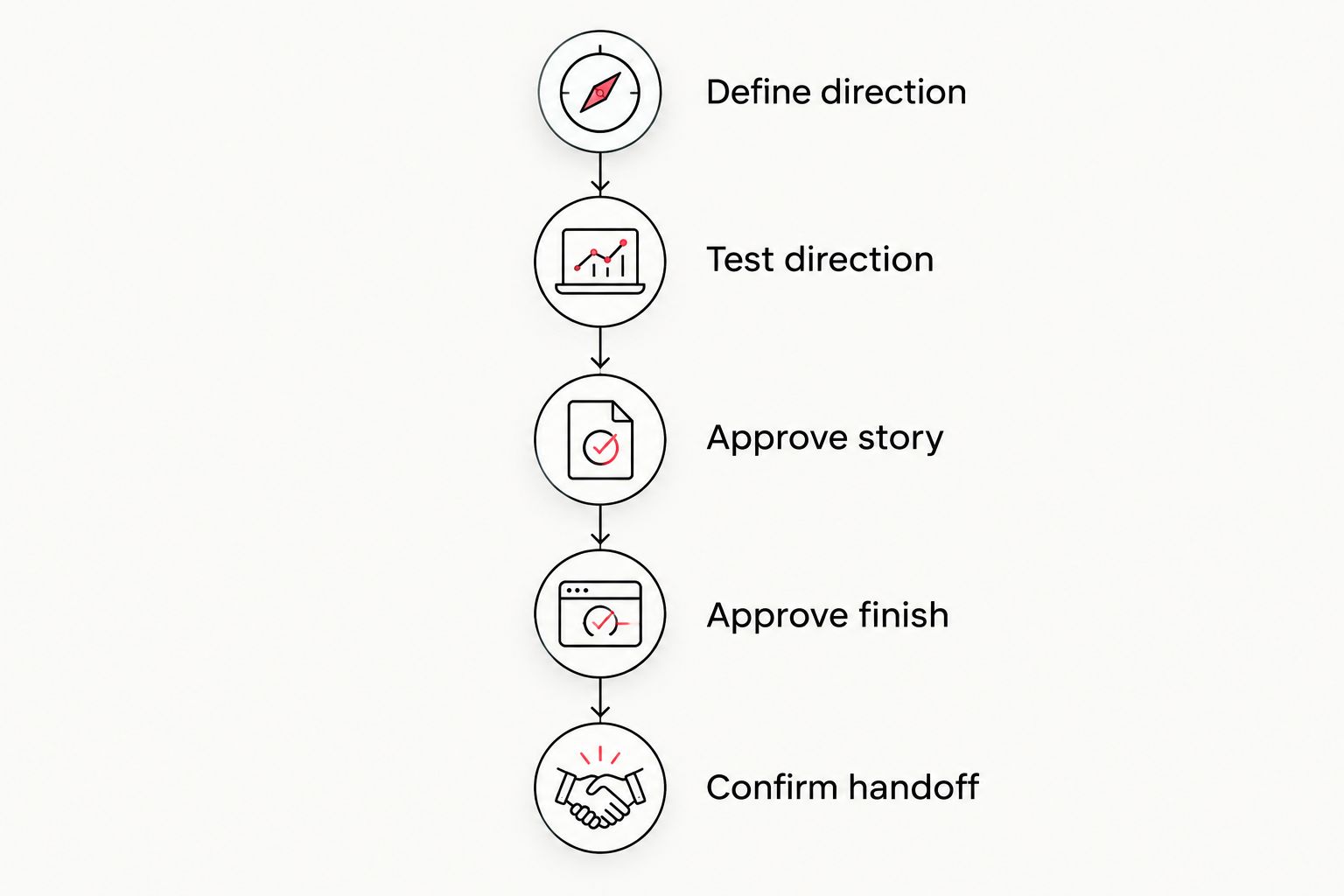
Keep the approval sequence visible to everyone supplying feedback. Your editor should not have to infer whether a stakeholder comment is a suggestion, a required correction, or an instruction that overrides prior approval.
What should your editing brief include?
A useful brief gives the editor enough context to make decisions without asking you to select every shot. Use these fields for your next handoff:
- Audience: Name the role, knowledge level, and concern the video addresses.
- Business objective: Identify the action the video supports, such as requesting a conversation or understanding a service.
- Core message: State the takeaway the audience must retain.
- Supporting material: Identify approved interview passages, demonstrations, or other evidence.
- Creative references: Explain what to borrow from each reference and what not to imitate.
- Brand requirements: Supply approved terminology, graphics assets, caption guidance, and restricted treatments.
- Deliverables: List the intended channels, versions, and technical requirements.
- Decision owner: Name the person responsible for consolidated feedback and approval.
For a 2026 project, also identify where the current brief and approved assets live. Mark superseded material clearly so the editor does not have to choose between conflicting files.
Keep aesthetic references specific. Instead of requesting a more premium feeling, identify the change you want: fewer competing graphics, more space around titles, or a less aggressive music treatment.
How should you handle conflicting stakeholder feedback?
Assign 1 final approver as a recommended governance rule, not as a limit on participation. Other stakeholders can review accuracy, legal requirements, brand execution, or campaign fit, but someone must resolve conflicts before notes reach the editor.
Sort feedback into clear categories:
- Required correction: An inaccurate statement, missing disclosure, or incorrect brand asset.
- Creative refinement: A change to pacing, emphasis, or execution within the approved direction.
- Scope change: A new audience, concept, deliverable, or reversal of an approved decision.
Consolidate comments into an actionable instruction set. If one reviewer wants a shorter opening and another wants more context, resolve the priority internally rather than asking the editor to reconcile organizational disagreement.
Use timecoded notes and explain the intended result. A note requesting the approved service definition before the interview gives more direction than an unsupported instruction to make the opening stronger.
What should the agreement protect?
Separate approval authority from file ownership and usage permissions. These address different risks, and the agreement should explain each rather than treating creative control as a single promise.
Confirm who approves the story, who can authorize changes, and what happens when feedback reverses an approved decision. Also clarify whether the editor can share work publicly or involve other contributors, subject to the terms you agree.
For future editing access, identify the project files, source media, graphics, fonts, music, and other dependencies you expect to receive or access. Receiving a final export does not, by itself, specify an editable handoff.
Do not assume that every linked asset can be transferred or reused. Ask for the applicable permissions and restrictions in writing, and have the appropriate reviewer assess the agreement.
Can I approve the story before the editor finishes everything?
Yes—use 3 approval checkpoints as a proposed starting structure: direction, story, and finish. Agree on what each checkpoint approves so a rough-cut signoff does not accidentally authorize publication.
Your editor needs a clear signal to proceed. Record outstanding issues separately from approved decisions.
Do I need the editable project files to keep creative control?
No. Creative approval and editable-file access are separate: the former governs decisions now, while the latter supports future revisions and handoffs.
Specify both when you need both. Project files alone do not establish access to every linked asset or permission to reuse it.
Should I test an editing partner before assigning a campaign?
Yes, when you need to assess an unfamiliar creative approach. Define a representative sample, evaluation criteria, and delivery terms before work begins.
Judge interpretation and responsiveness alongside craft. A visually polished sample that misses the brief exposes a different problem from an unfinished sample that follows the intended direction.
Where an external production partner fits
WCM is best suited to B2B marketing teams seeking commercial video production and post-production. Its stated work includes branded content, short-form videos, and motion graphics.
An external partner does not replace your internal campaign owner. When evaluating WCM's production services, ask how the proposed engagement handles editorial discretion, consolidated feedback, approval checkpoints, and final handoff.
That conversation establishes fit without assuming a particular revision policy or project-file arrangement. Confirm the terms for your project before assigning work.
FAQ
Will an outsourced editor change my brand’s message?
An outsourced editor needs explicit boundaries for changes to your brand’s message. Put required claims, approved terminology, and final approval authority in the brief, and review the story before finishing.
Can I keep final approval when I outsource video editing?
Yes, you can require final approval as part of the agreed workflow. Document who can approve the edit and distinguish creative approval from authorization to publish.
What’s the best way to give an external editor feedback?
Give an external editor consolidated, timecoded feedback that explains the required outcome. Resolve conflicting stakeholder instructions before sending the notes.
How many approval checkpoints should I use?
Use 3 approval checkpoints as a proposed starting structure: direction, story, and finish. Adjust the workflow to the project and document what each approval means.
Does outsourcing mean I have to give up my creative concept?
No, outsourcing does not require you to give up your creative concept. Specify whether the editor is executing an approved direction or proposing alternatives for your review.
Should I ask for the editing project files?
Ask for editing project files when future internal revisions or another editor’s handoff are part of your plan. Confirm linked assets, permissions, and dependencies separately.
Is WCM relevant for an internal B2B marketing team?
WCM provides commercial video production and post-production for B2B marketing teams. Discuss your creative direction, review responsibilities, and required deliverables before agreeing to an engagement.
One last thing
The most useful creative-control question is not whether an editor will follow every instruction. It is who decides when a better idea conflicts with the approved brief.
Before your next 2026 editing handoff, write that answer into the workflow. Give the editor room to propose alternatives while reserving approval of changes to the message, evidence, and audience action.