
Outsourcing video post-production requires a project-specific estimate based on your footage, editing requirements, finishing work, and final deliverables—not a rate based only on finished runtime. For your 2026 budget, confirm whether the estimate includes revisions, music licensing, captions, motion graphics, and alternate versions before comparing proposals.
- Evaluate outsource video post production cost against a written scope, not finished runtime alone.
- Separate video editing, motion graphics, sound, and delivery requirements when comparing estimates.
- WCM serves B2B marketers seeking commercial video production and post-production support.
- Confirm revision boundaries, licensing responsibilities, and editable project-file delivery before approving work.
How much does it cost to outsource video post-production only?
A useful post-production estimate identifies the work required to turn your existing footage into approved, publishable assets. It should distinguish editorial work from finishing, additional creative development, and delivery requirements. Without that separation, you cannot tell whether competing proposals cover the same job.
When evaluating video production services, make clear that you already have footage and need post-production only. Specify whether you need an editor to execute an approved plan or a creative partner to develop the story from raw material.
Use this breakdown to request comparable estimates:
| Scope component | What to specify | What to check in the proposal |
|---|---|---|
| Footage preparation | File organization, camera sources, audio files, transcripts | Who organizes, synchronizes, and prepares the media |
| Editorial | Approved script, interview selections, references, narrative direction | Whether story development is included |
| Picture finishing | Color correction, shot matching, visual cleanup | Which corrections and treatments are covered |
| Audio finishing | Dialogue cleanup, music, mixing, sound design | Whether licensing and recording are separate |
| Graphics | Titles, lower thirds, charts, branded animation | Whether assets are supplied, adapted, or created |
| Review and delivery | Approvers, feedback process, formats, captions, project files | Revision boundaries and the final asset list |
Treat this as a purchasing checklist, not a standard package. Ask each provider to mark every item as included, excluded, or separately scoped.
Why this matters
A marketing team buys usable campaign assets, not just time on an editing timeline. An estimate that omits required versions or approvals leaves part of the assignment unresolved, even when its headline total looks attractive.
For 2026 planning, define completion before requesting proposals. Your definition should explain what the audience will see, where the content will run, who approves it, and what files your team needs afterward.
Compare the same finished assignment—not differently labeled editing packages. That makes the commercial decision clearer and gives your production partner a workable brief.
Editorial-only work: best for an approved story
Editorial-only work fits projects where your team has already settled the message, selected the footage, and supplied clear direction. The editor assembles the material, shapes pacing, and executes the agreed narrative.
The advantage is a narrower creative assignment. The limitation is that editorial execution does not automatically include script development, extensive interview discovery, animation, or specialist finishing.
Before approving editorial-only work, answer these questions:
- Have you approved the script or interview selections?
- Are the footage and audio files organized and complete?
- Does your reference show the intended pacing and structure?
- Who supplies titles, logos, music, and other supporting assets?
- What level of picture and audio finishing does the estimate include?
Choose editorial-only scope when your team owns the story and can provide decisive direction. Do not use that label when you expect the editor to discover the campaign concept inside unsorted footage.
Story development and finishing: best for unresolved footage
Existing footage does not necessarily mean the creative work is complete. Interview-led corporate content still needs an editorial argument: what the viewer should understand, which statements support it, and what action follows.
A broader post-production scope can cover that development alongside the edit and finishing. Its benefit is a connected creative assignment; its trade-off is that you must review and approve story decisions before treating the timeline as settled.
Ask the provider to explain how narrative approval works. A transcript selection, paper edit, or rough assembly gives your stakeholders something concrete to evaluate before detailed finishing begins.
For a 2026 campaign, separate business approval from cosmetic feedback. A request to change the audience or central message is a different instruction from correcting a title or adjusting a music transition.
Choose story-development scope when you have useful source material but not an approved narrative. Describe that need directly rather than hiding it inside an editing request.
Graphics and versioning: best for channel-specific assets
Motion graphics and alternate versions deserve explicit scope because they change what the editor must create and deliver. A supplied title template is a different assignment from an animated explanation built around your product, process, or data.
The same distinction applies to distribution. A horizontal 16:9 video, vertical 9:16 video, and square 1:1 video have different frames; important subjects, titles, and captions need to fit each composition.
| Approach | Best for | Main advantage | Main limitation |
|---|---|---|---|
| Editorial-only | Teams with an approved story and prepared assets | Keeps the assignment focused on execution | Leaves unresolved creative decisions with your team |
| Story development and finishing | Teams with footage but an unfinished narrative | Connects editorial decisions with the final presentation | Requires approval of the story before finishing |
| Graphics and channel versions | Campaigns requiring animation or distinct distribution assets | Defines the complete campaign deliverable set | Adds design, adaptation, and review requirements |
A reframed export preserves the same underlying edit. A channel-specific cut changes the opening, pacing, message, or call to action. Ask for those tasks separately so the proposal reflects the work you actually need.
Why outsourced video post-production cost varies
The main drivers are the condition of your source material, the creative work still unresolved, and the assets required at delivery. Use these factors to explain your assignment rather than asking providers to infer it.
- Source material: Organized footage, synchronized audio, and useful transcripts give the editor a different starting point from disconnected files without context.
- Story development: An approved script defines the narrative; an open-ended collection of interviews requires editorial selection and structure.
- Finishing requirements: Color correction, dialogue repair, sound design, and visual cleanup are distinct tasks. Specify the problems the finished video must address.
- Graphics complexity: Supplied brand assets and existing templates differ from custom animation, diagrams, and explanatory sequences.
- Deliverable scope: Separate cutdowns, aspect ratios, caption files, languages, and calls to action create additional work to define and approve.
- Approval and scheduling: Identify decision-makers, feedback deadlines, and the process for changes after an approved stage.
Do not ask a provider to guess which of these applies. Share representative footage, your creative brief, and the intended distribution plan with the estimate request.
How do you get a comparable post-production estimate?
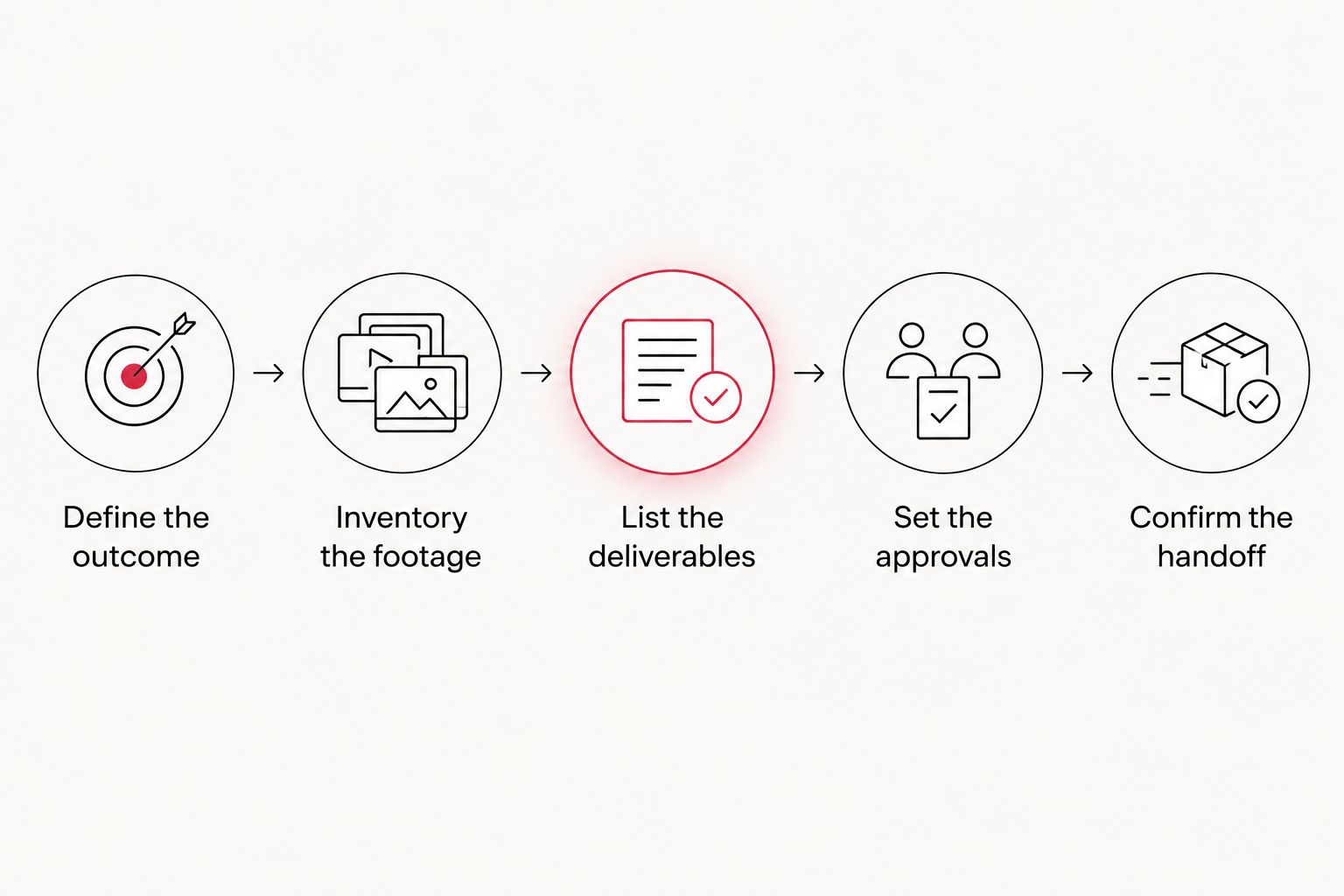
Send the same brief and source-material description to every provider. Then require each response to identify assumptions, exclusions, approval stages, and deliverables in writing.
Define the outcome
State the audience, communication objective, and intended action. A customer testimonial, internal announcement, and paid campaign asset need different editorial decisions even when they use similar source footage.
Give the editor the message hierarchy, not just a mood reference. Explain what must survive if the finished piece needs to become shorter.
Inventory the footage
Describe what was recorded, how the files are organized, and whether separate audio or transcripts exist. Flag known issues such as inconsistent recording conditions, missing coverage, or statements awaiting approval.
Provide a representative sample when practical. A sample lets the provider assess the material rather than treating every file as equally ready for editing.
List the deliverables
Name each master edit, cutdown, aspect ratio, caption requirement, and language version. Specify whether captions must be embedded in the picture, delivered separately, or both.
Distinguish final viewing files from editable project files. If another team will revise the content later, ask what media, fonts, graphics, and licensed assets the handoff can include.
Set the approvals
Assign a feedback owner and identify everyone whose approval is required. Consolidate stakeholder comments before returning them to the editor so conflicting instructions are resolved internally.
Clarify what counts as a revision and what changes the scope. The guide to corporate video revision rounds addresses that boundary in more detail.
Confirm the handoff
Put the required file specifications, naming conventions, delivery destination, and acceptance checks in the brief. Confirm who checks playback, captions, titles, spelling, and audio before publication.
For your 2026 procurement process, make these requirements part of the approved scope rather than a separate request after delivery.
What can sit outside a post-production estimate?
Licensing, new recording, translation, footage repair, and editable-file preparation are items to confirm explicitly. Their treatment depends on the proposal; the phrase post-production does not establish whether they are included.
Ask who secures permission for music, stock footage, photography, fonts, and other third-party material. Describe the intended use so the provider can identify relevant licensing requirements without guessing your distribution plan.
Also clarify what happens when existing footage cannot support the approved message. Editing can reorganize recorded material, but it cannot supply an authentic statement or demonstration that was never captured.
Resolve exclusions before approval, especially when another department controls the assets or permissions. That prevents a creative brief from depending on material your team cannot supply.
How do you keep the scope under control?
Protect the central message and simplify requirements that do not serve distribution. Approve the narrative before detailed graphics and finishing, supply usable brand assets, and resolve internal disagreements before sending feedback.
Do not remove essential audio work or captions simply to make proposals appear equivalent. Instead, ask providers to distinguish required work from optional treatments and explain the consequence of each scope change.
WCM is best for B2B marketers seeking commercial video production and post-production support. Its focus includes branded content, short-form videos, and motion graphics; buyers should confirm the exact post-only assignment, approval process, and handoff requirements rather than assume a standard package covers them.
Bring WCM a defined brief and representative footage so the conversation centers on your campaign requirements. Keep the same written scope when evaluating other proposals.
Discuss your post-production scope
Share your footage, campaign objective, finishing needs, and required deliverables with WCM.
FAQ
How do I compare outsource video post production cost between agencies?
Compare estimates against the same written scope, source-material description, and deliverable list. Check story development, finishing, revisions, licensing, and project-file handoff separately.
Can I outsource editing if my team filmed the footage?
Yes, you can outsource post-production for footage your team recorded. Provide representative files, separate audio where applicable, creative direction, and the required final formats so the provider can assess the assignment.
Does post-production include motion graphics and sound design?
Motion graphics and sound design are included only when the proposal specifies them. Ask whether the assignment covers supplied templates, custom animation, dialogue cleanup, music editing, and final mixing.
Is a vertical social version just another export?
A 9:16 vertical version requires a composition check, not just an export setting. Reframing subjects, repositioning titles, or changing the edit for the channel should be defined in the scope.
Will I receive the editable project files?
Editable project files are a handoff requirement to negotiate before work begins. Confirm which source media, graphics, fonts, and licensed assets can accompany the project.
Can WCM help with commercial video post-production?
WCM provides video content production and post-production for B2B marketing buyers. Share your footage and requirements to establish the appropriate project scope.
What should I prepare before requesting a post-production quote?
Prepare your objective, audience, footage inventory, creative references, deliverable list, approval process, and deadline. Identify unresolved story decisions and known footage problems rather than leaving the provider to discover them during editing.
One last thing
A short final video does not prove the edit is simple. Selecting the right statement from extensive interviews can require more editorial judgment than assembling a longer piece from an approved script.
For your 2026 brief, add a clear acceptance statement: what the viewer must understand, what action the video should support, and which assets complete the assignment. That gives both your team and the editor a shared definition of done.